

This post may contain affiliate links. If you use these links to buy something we may earn a commission at no extra cost to you. Thank you for your support!
A client does not need a full-time employee just because they need help with email campaigns, customer support, video editing, or lead generation. That shift sits at the center of remote work trends and creates a major opportunity for freelancers who can solve specific business problems from anywhere.
For service providers, the headline is not simply that more people want to work from home. It is that companies are rebuilding how work gets done. They are hiring smaller, distributed teams, bringing in specialists for defined outcomes, and expecting contractors to communicate like trusted partners. Good news: you do not need to be a tech founder or a corporate executive to benefit. You need a marketable skill, a clear offer, and business habits that make clients feel confident hiring you remotely.
The Remote Work Trends Changing Freelance Demand
Remote work is no longer one uniform arrangement. Some companies are fully distributed, some use hybrid schedules, and others keep core staff in-house while relying on remote contractors for specialized work. Each model creates different needs, and freelancers who understand those needs can position themselves far better than someone offering a vague list of services.
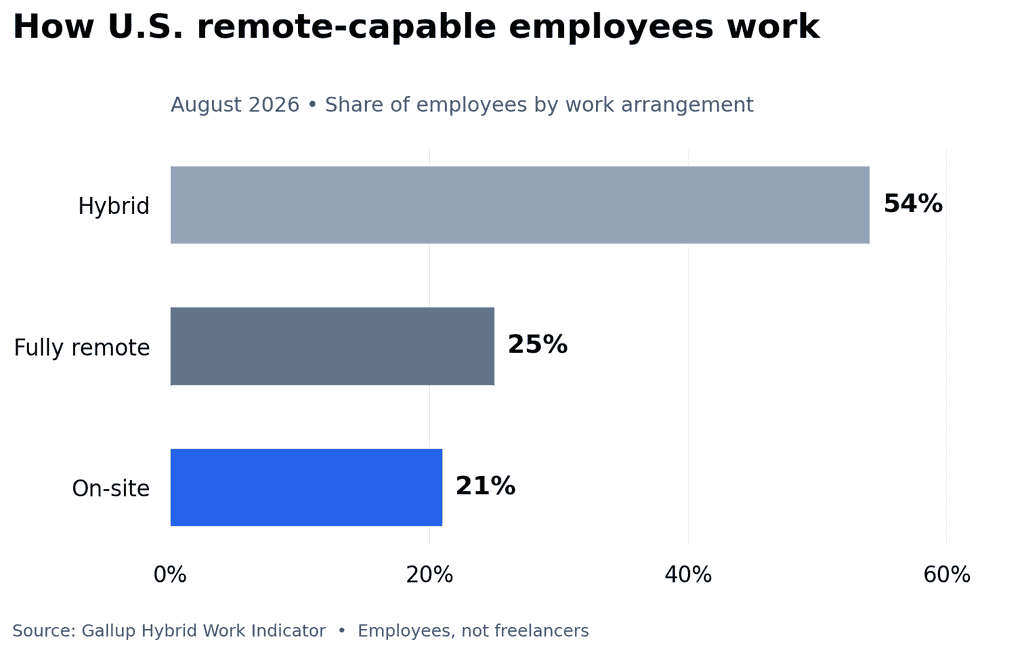
Remote work is still firmly established in many industries. According to Gallup’s hybrid-work research, as of August 2026, 54% of U.S. employees in remote-capable jobs worked in hybrid arrangements, while another 25% worked exclusively remotely. These figures cover employees rather than freelancers, but they show how widely distributed working arrangements have become.

Businesses are hiring for outcomes, not extra hands
A business owner rarely wakes up wanting to hire “a freelancer.” They want their inbox managed, their social content scheduled, their sales page improved, their podcast edited, or their ad leads followed up. Remote work has made it easier for businesses to buy expertise in focused pieces.
This favors productized services. Instead of saying, “I can help with marketing,” a freelancer might offer monthly email campaign management for e-commerce brands or short-form video editing for coaches. The work can still be customized, but the outcome is easy for a client to understand, compare, and approve.
Asynchronous communication is becoming a premium skill
When clients and freelancers work across time zones, constant meetings become expensive and tiring. Strong remote operators know how to move work forward without waiting for a reply every hour. They write clear updates, document decisions, ask smart questions upfront, and deliver work in organized folders or project spaces.
This is especially valuable for virtual assistants, project managers, copywriters, designers, web developers, and social media managers. Your communication system can become part of your offer. A client is not only paying for the final deliverable. They are paying for less mental load.
AI is raising the bar for basic execution
AI tools can produce first drafts, summarize calls, organize notes, create simple graphics, and speed up research. That does not mean clients no longer need freelancers. It means low-value, generic work is harder to sell at premium rates.
The opportunity is to pair AI speed with human judgment. A copywriter who understands conversion psychology, brand voice, and customer research brings much more value than someone pasting unedited AI text into a document. A social media manager who can turn customer insights into a content strategy is more useful than one who only generates captions.
Use the tools, yes. But sell the thinking, strategy, quality control, and business result behind the tools. Canva Pro works well for this when you want to speed up simple graphics while keeping every client deliverable on brand.

Location flexibility is expanding the talent pool
Remote work lets clients hire globally, which can create more competition. It also lets you work with clients outside your city, state, or country. A skilled freelancer in Malaysia, Singapore, or the United States can serve a business anywhere if expectations, payment terms, and communication are handled professionally.
Remote work is not equally common everywhere. A 2025 Stanford-led international study found that working from home among college-educated employees had broadly stabilized after 2022, with substantial differences between countries. This is a useful reminder that freelancers should research the working practices and expectations of the markets they want to serve, rather than assuming every country operates the same way.
The trade-off is that clients have more choices too. Your response cannot be to compete only on price. Build a visible niche, show proof of your process, and make it easy to understand why your service is worth hiring.
Where Remote Freelance Opportunities Are Growing
The best service is not always the newest or flashiest one. Consistent demand often comes from work that businesses need every month to acquire customers, serve customers, or keep operations organized.
| Remote service area | Why clients hire for it | A stronger positioning angle |
| Email marketing | Revenue depends on follow-up, promotions, and retention | Build and manage revenue-focused email campaigns |
| Short-form video editing | Brands need frequent content for visibility | Edit conversion-minded clips for coaches or product brands |
| Virtual assistance | Founders need calendar, inbox, and operations support | Become an operations VA for a specific industry |
| Paid ads support | Campaigns require creative, reporting, and lead follow-up | Support agencies or businesses with Meta ads execution |
| SEO content services | Companies need helpful content that earns attention over time | Write and optimize content for one buyer type or niche |
| Community management | Online communities need engagement and moderation | Manage member experience for courses, memberships, or SaaS brands |
| CRM and automation setup | Leads get lost when systems are disconnected | Build simple lead follow-up systems for service businesses |
Notice the pattern: these services connect to revenue, retention, visibility, or efficiency. That is where budgets tend to hold up better than for tasks with no clear business impact. MailerLite works well for this if you want to offer email campaign services without paying for heavy software.
What Clients Expect From Remote Freelancers Now
Remote clients are not looking for perfection. They do expect reliability. If you want to earn your dream income from home, treat reliability as a skill you actively build, not just a personality trait. As remote work trends push more clients to hire online, reliability becomes one of the clearest ways to stand out.
First, create a clean onboarding experience. A new client should know what you need from them, when they can expect updates, where files will live, and how revisions work. Even a one-page welcome document can make a newer freelancer look far more established.
Second, set communication boundaries without becoming hard to reach. You may not need to reply instantly, but clients should know when they will hear from you. A weekly update that covers completed work, current priorities, and items waiting on feedback prevents many unnecessary messages. Notion works well for this when you share a simple client dashboard with a weekly update and a list of items waiting on feedback.
Third, manage scope early. Remote projects can blur quickly when requests arrive in chat messages at random times. Confirm new requests in writing, explain whether they fit the current agreement, and quote additional work when needed. This protects your time and signals that you operate like a business.

How to Position Yourself for These Remote Work Trends
You do not need to chase every trend. In fact, trying to offer copywriting, design, ads, admin, funnels, and video editing all at once can make your marketing harder. Pick one service you can deliver well, then connect it to a client outcome.
A useful positioning formula is: I help [specific client type] achieve [specific result] through [specific service]. For example: “I help online course creators turn long videos into short-form content that brings in qualified viewers.” It is clearer than “I am a freelance video editor,” and it gives potential clients a reason to remember you.
Then strengthen the proof around that offer. If you have client results, share them with context. If you are newer, create samples based on realistic business scenarios, document your process, or complete a small pilot project. Proof does not need to be flashy. It needs to reduce a buyer’s uncertainty.
Pricing should reflect the value and complexity of the work, not only the number of hours on your clock. Hourly rates can make sense for ongoing support and unpredictable tasks. Fixed project fees work well when the scope is clear. Monthly retainers are often a strong fit for recurring remote services such as social media management, email marketing, content editing, or VA support.
The right model depends on the service. A funnel build has a defined beginning and end, while inbox management has shifting weekly needs. Choose the structure that lets you deliver quality work without constantly renegotiating tiny requests.

Build a Remote Business That Clients Want to Keep
Winning a remote client is one milestone. Becoming the person they do not want to replace is where stability grows. Look for ways to improve the system around your service. A designer can create a brand asset library. A copywriter can maintain a messaging guide. A VA can document recurring workflows. These additions make your work more valuable and make handovers less attractive to the client.
At the same time, keep ownership of your skill development. Learn the tools your clients use, but do not build your whole identity around one platform. Tools change fast. Clear communication, strategic thinking, persuasive writing, organized delivery, and client management travel with you across every tool and market. Set aside time each month to study how remote work trends are shifting, so your skills stay as current as your offer.
The freelancers who benefit most from remote work are not necessarily online all day or saying yes to every request. They build a reputation for making business easier. Start shaping your offer around that promise, and you give clients a very good reason to hire you from anywhere.