
This post may contain affiliate links. If you use these links to buy something we may earn a commission at no extra cost to you. Thank you for your support!
The AIDA formula stands for Attention, Interest, Desire, and Action. It is the most popular copywriting model in the world, a classic marketing framework that has been around since the late 19th century, created by American advertising pioneer Elias St. Elmo Lewis in 1898.
“The mission of an advertisement is to attract a reader, so that he will look at the advertisement and start to read it; then to interest him, so that he will continue to read it; then to convince him, so that when he has read it he will believe it.” — Elias St. Elmo Lewis
More than a century after Elmo Lewis first wrote those words, the best copywriters in the world still use this framework. Not because they lack imagination, but because human psychology has not changed. People still need to be stopped, held, persuaded, and directed.
The AIDA copywriting formula is the structure that makes that happen, whether you are writing sales letters, a cold email, an Instagram ad, a YouTube channel description, or a landing page for a product launch.
If you are ready to start your online journey and earn an additional $2–3K in monthly income through copywriting, check out my course, The Copywriting Society.
What Is AIDA Copywriting?
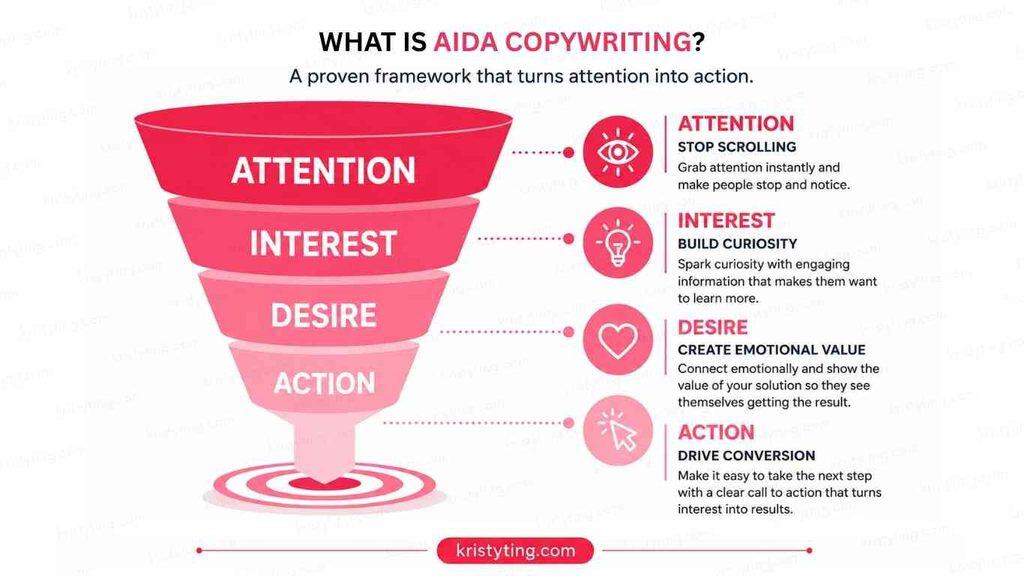
The AIDA copywriting formula is a four-stage framework that moves a reader from complete stranger to paying customer, one step at a time. It is the copywriting framework behind some of the highest-converting sales letters, sales pages, and marketing campaigns ever written, and it still works because it mirrors how people actually make decisions.
Here is how each stage works:
First, you grab their attention. Say something bold, specific, or relatable that stops the ideal reader cold and makes them think, “Wait, that is me.”
Then you build their interest. Talk about their problem like you have lived it yourself. Show them you understand what they are going through, not in a vague way, but with the kind of detail that makes them feel genuinely seen.
After that, you create desire. Paint the picture of life after their problem is solved. Make them feel the outcome, not just understand it.
Finally, you ask them to take action. Click this. Buy that. Book a call. A clear call to action is not optional; without it, even the best copy in the world converts at zero.
Legendary writer Gary Halbert, who produced some of the most profitable direct mail campaigns in history, built his entire copywriting process on this exact progression. Attention-grabbing headlines at the top. A hook that pulled readers in. Desire built through story and specificity. And a clear call to action at the end that left no room for confusion.
As Ann Handley, bestselling author of Everybody Writes, puts it:
“Make the reader the hero of your story.” — Ann Handley
That is the AIDA copywriting formula in one sentence. It is not about your product. It is about your audience members and the journey you take them on. And that customer journey from cold stranger to convinced buyer is exactly what every stage of AIDA is designed to move people through.
Stage 1: Attention — Capturing Your Audience’s Attention
The first stage of the AIDA copywriting formula is the most important. Before your readers can ever become potential customers, you have to stop them in their tracks first. No hook, no reader. No reader, no sale.
The first step is not to write; it is to understand who you are writing to. Attention-grabbing headlines, surprising statistics, bold statements, and thought-provoking questions are all effective ways to stop the scroll and spark readers’ curiosity. But none of them work if they are aimed at the wrong person.
At the beginning of an article, sales page, or Instagram ad, you have a fraction of a second to earn the reader’s attention. The reader’s eyes are scanning for a reason to keep going or a reason to leave. A great headline gives them a reason to stay.
Here is a good example of the difference a headline makes:
Weak: “Learn Copywriting Online”
Strong: “How I Went from Writing Free Content to Charging $3K Per Client — In 90 Days”
The second one is specific, outcome-driven, and speaks directly to a real aspiration. It captures the attention of readers who are exactly the kind of person the course is built for and filters out everyone else. That filtering is intentional. A catchy headline that attracts the wrong audience is just noise.
One thing that trips up a lot of new copywriters: the best approach differs across different audiences and channels.
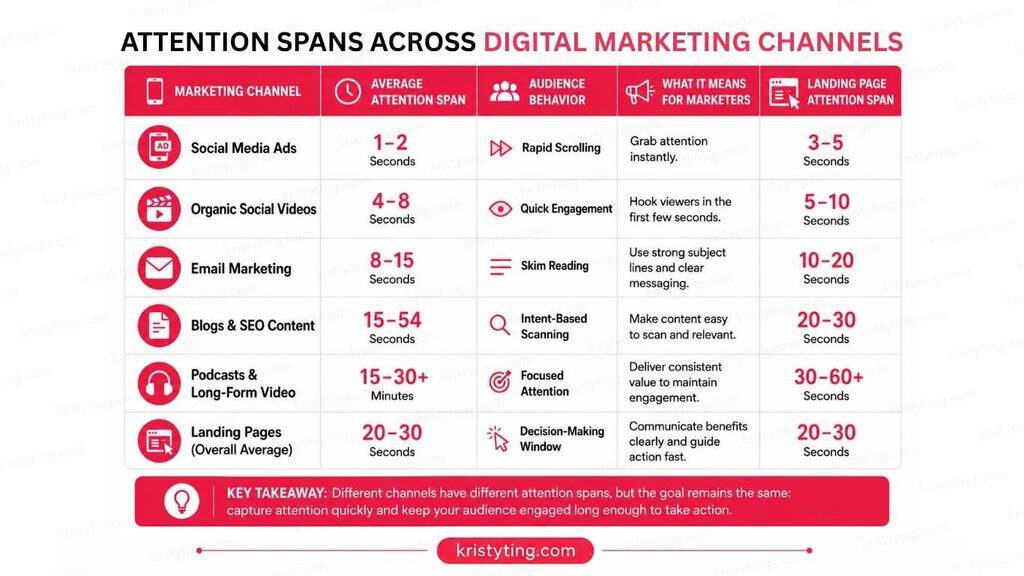
A hook that works in a cold email does not always land the same way on an Instagram ad.
A YouTube channel thumbnail needs to communicate the value of a video before a single word is heard.
A landing page has slightly more time to win the audience’s attention than a social media post, but not much. Understanding those context differences is what separates average from better copy.
Start With Listening, Not Writing
You cannot write a hook that resonates if you do not know who you are talking to. Writing a great headline does not start with writing, it starts with listening. Before you write a single word, marketers must understand the pain, interests, and lifestyle of their target audience in order to create an effective marketing message.
Speaking in your customer’s language, not yours, is always the best way to connect. Marketing messages that miss this feel generic. The ones that nail it feel like the writer read your journal. The most effective way to get this right is to build a buyer persona: a detailed profile of your ideal reader that covers their demographics, goals, frustrations, buying triggers, and the exact words they use when they describe their own problems.
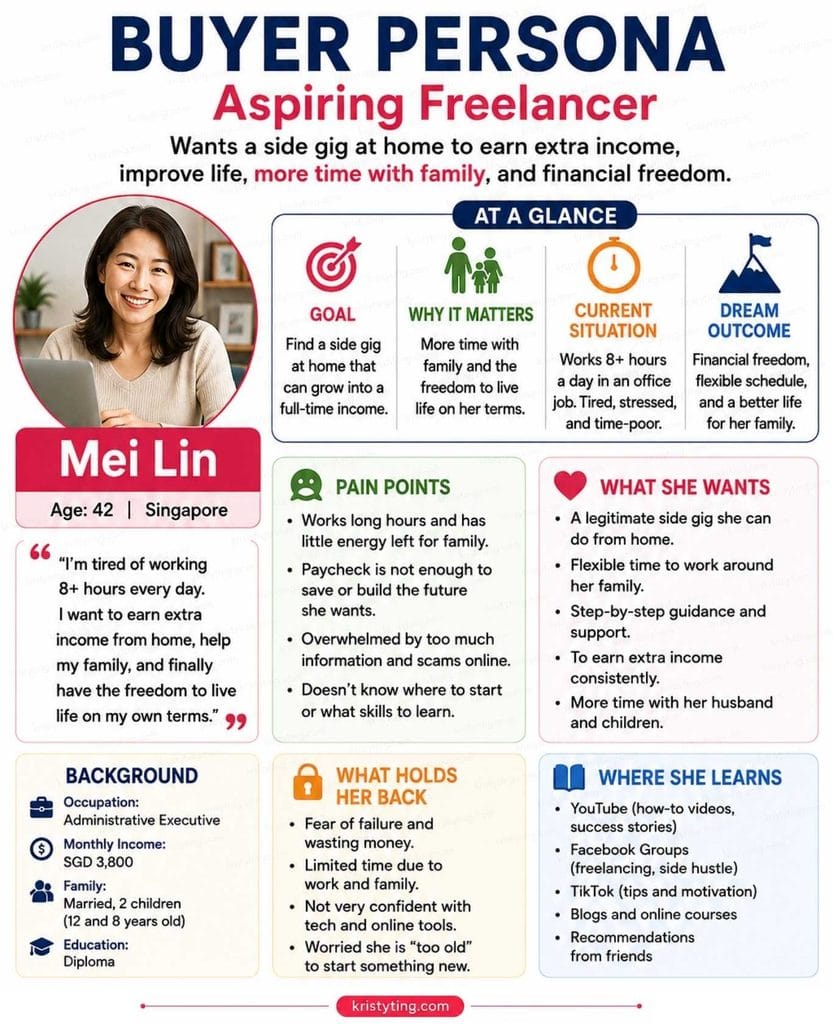
Ann Handley calls this “pathological empathy,” the ability to put yourself so completely inside your ideal reader’s world that your writing feels like it was pulled from inside their own head. It sounds dramatic. But it is the difference between copy that converts and copy that just fills a page.
How the Attention Stage Looks in Practice
A good example of this is the headline used on the Copywriting Society course page:
“Add $2–3K To Your Monthly Income With One High-Income Skill”
This works because it is specific (an actual income figure), outcome-focused (what the reader gains), and creates curiosity about how one skill could do all that. It is built to capture the attention of a very specific reader, someone who wants to earn more and is open to building a new skill, and it moves them straight into the next stage.
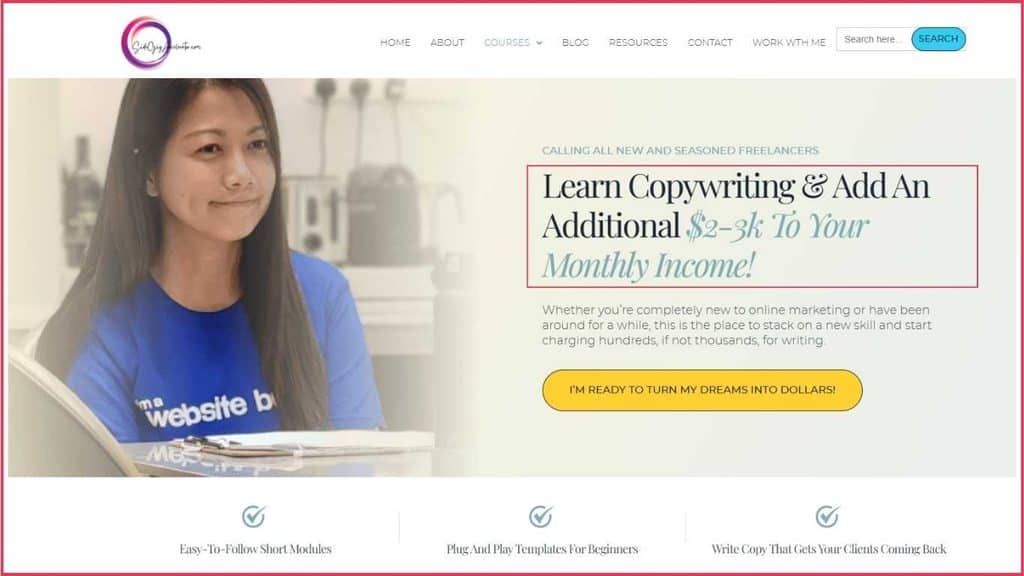
AIDA Copywriting Example: The Attention Stage
Note the use of plenty of white space around the headline on the actual page. That visual breathing room is not just design; it directs the reader’s eyes straight to the most important line on the page.
Stage 2: Interest — Keep Them Hooked Once You Have Got Them
Grabbing their attention was the hard part. Now you have to keep it. This is where most copy falls apart.
Writers nail a great headline, then immediately start talking about themselves or their product. Big mistake. The interest stage is not about you; it is about them.
Start by addressing a real, current problem in their life. Speak to it like you have lived it yourself. When your audience members read your copy and think, “Wait, this person gets me,” that is the moment you have won their audience’s interest. That recognition is what keeps them reading line by line.
Then back it up with facts. Interesting statistics, real data, and specific details show your target audience that you know what you are talking about. There is a sequencing principle here that Ann Handley writes about at the end of her blog posts and throughout Everybody Writes: The fourth paragraph talks about your product only after you have established that you understand the reader’s world. Lead with empathy, follow with evidence. That order matters.
Personalization is also essential. The best way to do this is through storytelling. Share an experience from your own life, a mistake you made, or a lesson you learned. Or use testimonials from real customers and let their words do the talking. People remember stories far longer than they remember facts alone. It makes your marketing messages feel human, not manufactured.
Think of the interest stage as a phone call with a prospect you just met. You would not lead with your credentials or your product. You would say, “I know exactly what that feels like.” That is the energy this stage needs, and it is one of the most creative ways to differentiate copy that converts from copy that just informs.
How the Interest Stage Looks in Practice
After the headline on the Copywriting Society course page, the copy moves directly into the reader’s world:
“You’re doing everything right — showing up, putting out content, taking on clients. But the income still feels inconsistent. And you know your skills are worth more than what you’re charging.”
That is not about the course. It is about the reader. It identifies the gap between where they are and where they want to be. The bullet points that follow then highlight specific outcomes, not features, but the next steps a frustrated freelancer actually wants to take.
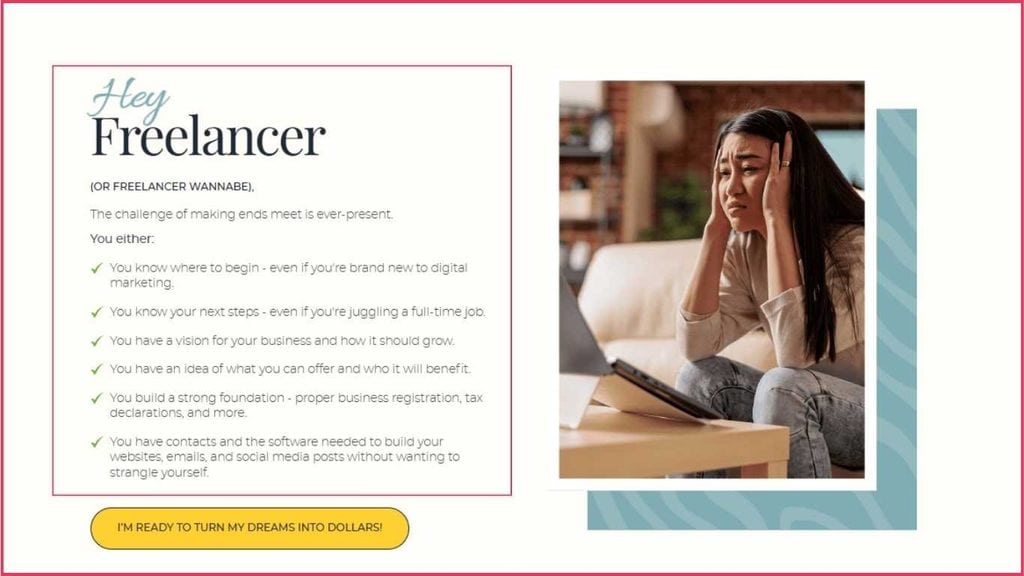
AIDA Copywriting Example: The Interest Stage
Stage 3: Desire — Turning Interest Into Want
Once you have built their interest, the desire stage is where you shift readers from “this is interesting” to “I actually want this.”
Start by making a clear pitch but lead with the benefits of your product, not the features. Instead of telling people what your product or service does, explain how it will make their life easier, save them time, reduce stress, or help them achieve something they genuinely care about.
The most effective copy at this stage works with emotional triggers. Someone may say they want to learn copywriting to earn extra income. But their real desire might be spending more time with family, gaining financial independence, or finally leaving a job they no longer enjoy. Tapping into those deeper motivations is what separates copy that creates desire from copy that just lists information.
Legendary writer Gary Halbert used to say that the entire sales letter should be building toward one thing: the future the reader wants. What does their life look like after they buy? That vision built across the whole copywriting process, from attention all the way to desire, is what makes people reach for their credit card.
This is also where you add social proof. Testimonials, case studies, success stories, certifications, and real results from real people all tell the reader: this works. Others have already made it happen. When people see evidence that your solution delivers, their confidence increases and so does their desire for it.
A good example of this principle in action: Vice Magazine’s digital campaigns almost always lead with social proof from real audience members before presenting any product or offer. It is not a generic statement from the brand. It is someone just like the reader saying: “This changed things for me.” That is the effective way to build desire in any format.
How the Desire Stage Looks in Practice
The Copywriting Society course page uses a “What If…” section to open up the reader’s imagination:
“What if you had a skill that clients actively sought out — and a rate card to match? What if inconsistent income was behind you, and booked-out months were the new normal?”
Then a “No Longer Do You…” section mirrors it, showing the frustrations that disappear after buying. Both sides of the desire equation: what they gain, and what they leave behind. That combination is what moves someone from interested to ready.
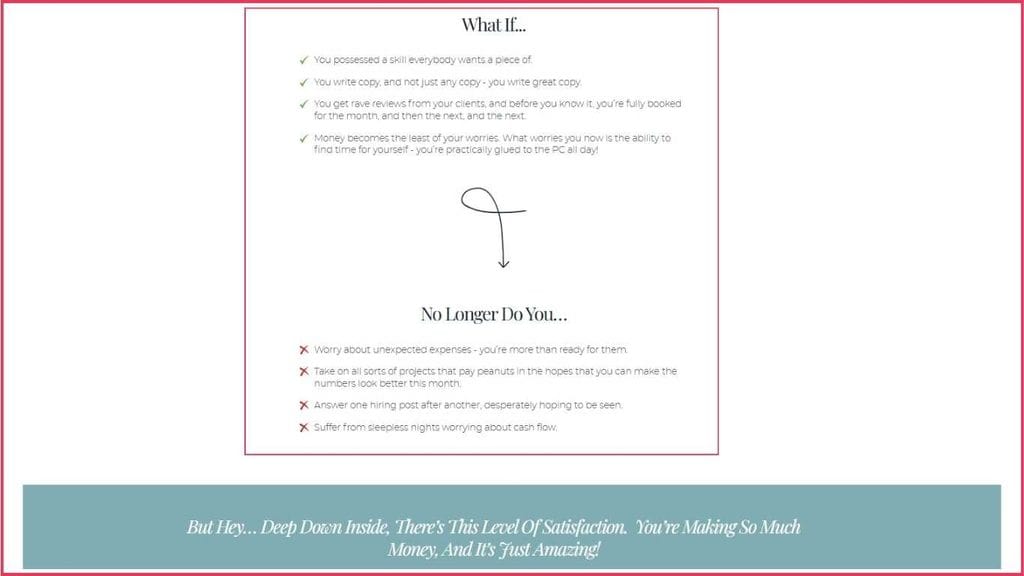
AIDA Copywriting Example: The Desire Stage
Stage 4: Action — Turning Desire Into Conversions
The final stage of the AIDA model is where you turn desire into a desired action. After showing readers how your solution can change their situation, you tell them exactly what to do next.
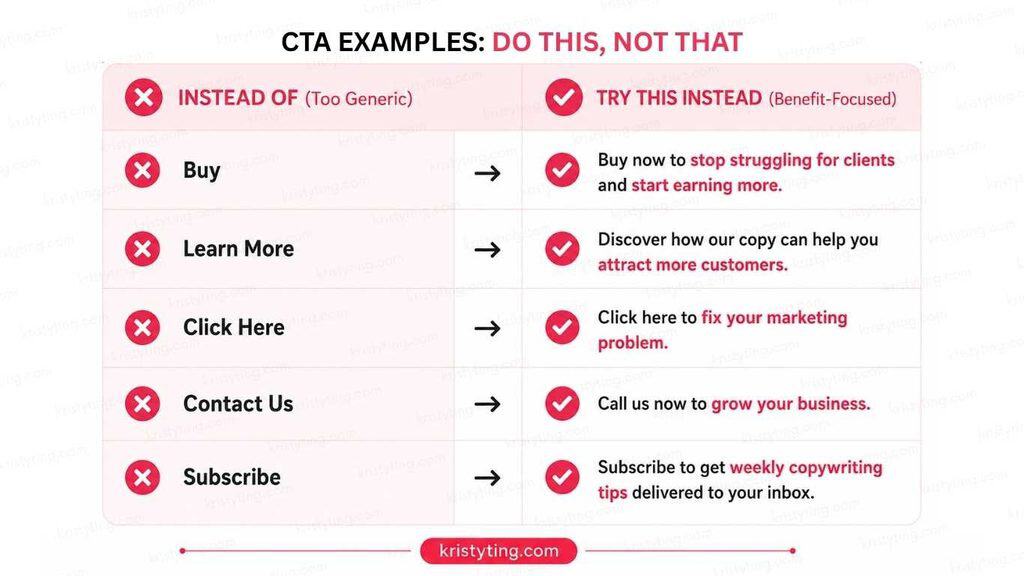
Use a clear call to action. Not clever. Not subtle. Clear. Tell readers precisely what happens when they click, what they are signing up for, and what they get. A clear call to action removes friction. The lower the friction, the higher the conversion.
Keep it simple; give your reader one next step. Too many options create decision fatigue and reduce conversions. A landing page with three different CTAs almost always underperforms one with a single, well-written, clear call to action.
You can also increase action by creating a sense of urgency. Limited-time bonuses, enrollment deadlines, best deals available only for a short window, and special offers all encourage readers to act now rather than bookmarking the page and never returning. The key word is “real,” and fabricated urgency damages trust fast, and smart audiences will see through it.
The final step is simple: make the next step clear, compelling, and easy to take.
How the Action Stage Looks in Practice
After building the case through the earlier stages, the Copywriting Society page ends with:
“YES! I WANT TO MAKE MONEY WITH COPYWRITING!”
Notice it is benefit-driven even in the button copy. Not “Submit” or “Enrol Now.” The reader is clicking toward something they want. That is a small distinction that makes a real difference to conversion rates.
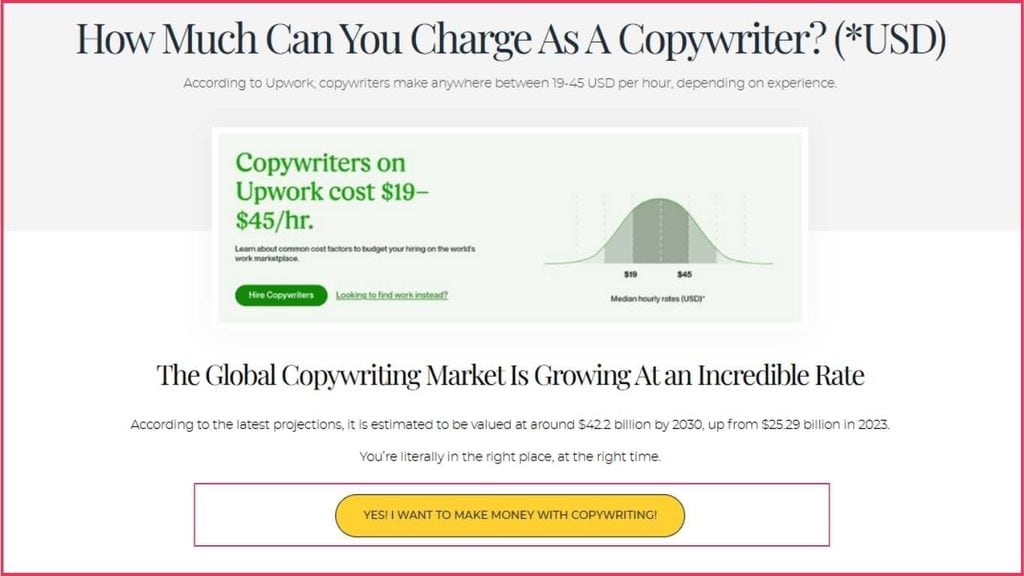
AIDA Copywriting Example: The Action Stage
Examples of the AIDA CopywritingFramework Across Different Formats
Let us have a good look at how the AIDA copywriting formula works across different formats and different scenarios. One of the strengths of this copywriting framework is that it adapts from sales letters and sales pages to short social media content and cold email sequences, without losing its structure. Here are some of the best examples of the AIDA framework in action.
Example 1: Instagram Ad
An Instagram ad has almost no time to work with. Scroll speed is brutal. Here is how AIDA compresses into short-form social media content for an Instagram ad promoting a freelance copywriting workshop:
Still charging $10 per article? [Attention] Most copywriters stay stuck at low rates not because they lack talent — but because they’ve never learned how to package and price their skills properly. [Interest] What if you could walk away from this weekend knowing exactly what to charge, how to pitch, and how to attract clients who don’t negotiate? [Desire] Spots close Friday. Link in bio to register. [Action]
Four stages. Eleven lines. Short sentences throughout. No wasted words. The attention-grabbing headline (“Still charging $10 per article?”) is specific enough to stop the right reader and scroll past anyone else. The clear call to action at the end gives one next step. That is the Instagram ad equivalent of a well-structured sales letter, just compressed into a caption.
Example 2: Cold Email
Cold email lives or dies on the first line. The beginning of an article and the subject line of a cold email have more in common than most people think; both need to earn the right to be read in under two seconds. Here is a cold email to a small business owner that follows the AIDA copywriting formula:
Subject: Your website visitors are leaving without buying Hi [Name], I was browsing your site earlier and noticed something that might be costing you leads every day. [Attention] Most service-based businesses lose 70–90% of visitors who never come back — not because the offer is wrong, but because the copy doesn’t give them a reason to stay. [Interest] I help small business owners rewrite their web copy to convert cold traffic into booked consultations — usually within 30 days. Here’s a case study from a client I worked with last quarter. [Desire] Would a 15-minute phone call this week make sense to see if I can do the same for your site? [Action]
Notice the clear call to action at the end asks for one specific thing: a phone call. Not a sale, not a commitment, not a purchase. Just the next step. In a cold email, that is all the CTA needs to do.
This is also a good example of how to write to different audiences across different scenarios. A cold email to a government institution would use a different tone, more formal and more structured, but the same four-stage AIDA copywriting formula would still apply. The framework adapts. The stages do not change.
Example 3: Sales Page (Long-Form)
On sales pages and longer landing pages, the entire sales letter structure expands. The attention-grabbing headline goes above the fold. The interest section can run for several paragraphs. The desire stage brings in social proof, case studies, and testimonials. The action section closes with a clear call to action, urgency, and sometimes discount codes or the best deals for early buyers.
Legendary writer Gary Halbert’s famous “Coat of Arms” letter, one of the most successful direct mail campaigns ever written, is one of the best examples of this structure in its purest form. The effective headline stops you immediately. The fourth paragraph talks about your family history in a way that feels personally addressed to you alone. Desire builds across several pages. The action is a simple reply card. The entire sales letter is one long AIDA sequence.
A Moz article on landing page optimization is a good example of how this plays out in digital marketing. The Morphio example they cite shows a landing page where the fourth paragraph talks directly to the campaign’s main goal, uses Google Analytics integration data to demonstrate results, and closes with a lead magnet offer, all following the AIDA structure without ever labeling it as such.
Example 4: YouTube Channel Description and Video Script
A YouTube channel description needs to capture the audience’s attention fast and give new visitors a reason to subscribe. Here is an example:
Tired of working more and earning less? [Attention] Every week I share practical strategies for freelancers who want to charge better rates, attract better clients, and build a business that actually fits their life. [Interest] This channel has helped thousands of freelancers in Southeast Asia land their first $2K month — and their tenth. [Desire] Subscribe and hit the bell so you never miss a new video. [Action]
Within the individual YouTube channel scripts themselves, the AIDA copywriting formula maps across the video structure: an attention-grabbing hook in the first ten seconds, interest built through storytelling and interesting statistics in the first third, desire through examples and results in the middle, and a clear call to action at the end asking viewers to subscribe, leave a comment, or click a link.
Example 5: Email Marketing Sequence
In an email marketing sequence, the AIDA copywriting formula can stretch across multiple emails rather than fitting inside one. A good example of this is a four-part welcome sequence for new email subscribers:
- Email 1 (Attention): A subject line that stops the scroll and a story that hooks immediately. Something unexpected that makes the ideal reader think, “Okay, I need to read this.”
- Email 2 (Interest): Deeper education on the problem your target audience is living with. Pull in interesting statistics. Use storytelling. Show them you understand where they are.
- Email 3 (Desire): Social proof, results, and a clear vision of the transformation. Testimonials, case studies, specific outcomes. This is where desire is built.
- Email 4 (Action): A clear call to action, one next step, and an offer, whether that is a lead magnet, a sales page link, or a phone call booking.
This is also one of the reasons search engine marketing trends are moving toward nurture-first strategies. Audiences who are warmed through a properly structured AIDA sequence convert at significantly higher rates than audiences hit with a cold offer on the first touchpoint.
Example 6: Social Media Content (Friendly Voice)
Not all social media content needs to be hard-sell. Here is how AIDA works in a friendly voice, a short LinkedIn post promoting a free resource:
I used to spend three hours writing one email. Now I write five in a morning. [Attention] The difference wasn’t working harder. It was finally understanding the AIDA copywriting formula — and building a simple template around it. [Interest] I put everything I know about writing faster without losing conversion into a free guide. Real examples, real templates, none of the fluff. [Desire] Comment “AIDA” below and I’ll send it to you directly. [Action]
Different approaches work for different platforms and different audiences. The friendly voice above fits LinkedIn’s culture of peer-to-peer sharing. An Instagram ad might be more punchy. A cold email would be more direct. A sales page would go deeper. But the underlying AIDA copywriting formula stays the same across all of them.
Let’s have a good look at how I use AIDA copywriting in real-world marketing examples.
- 1. Here’s how I use the AIDA copywriting framework to write an engaging social media caption in a friendly, conversational tone.
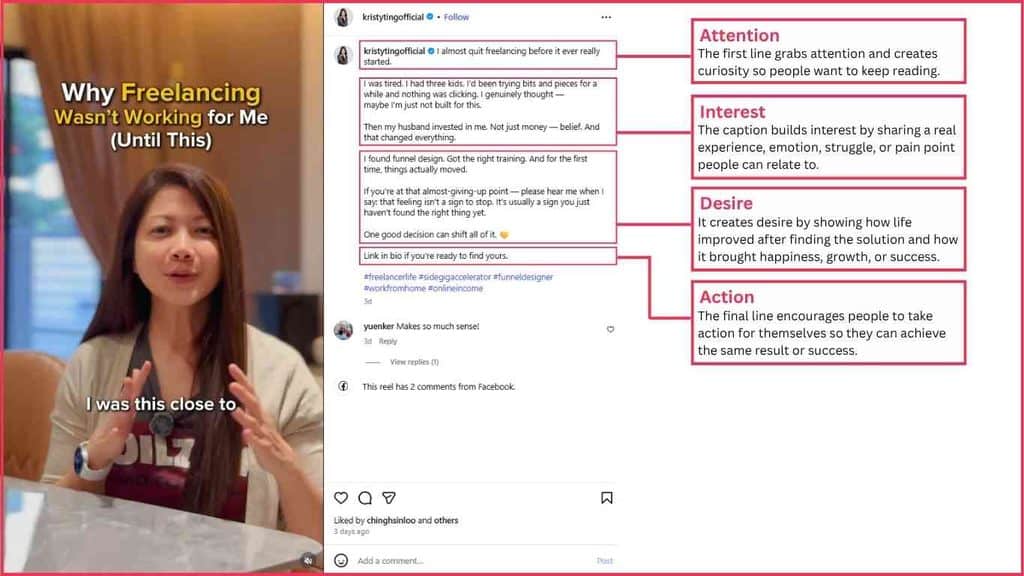
AIDA copywriting: kristytingofficial Instagram Post Caption
- 2. Here’s an example of how I apply AIDA copywriting to a landing page for my Side Gig Masterclass.
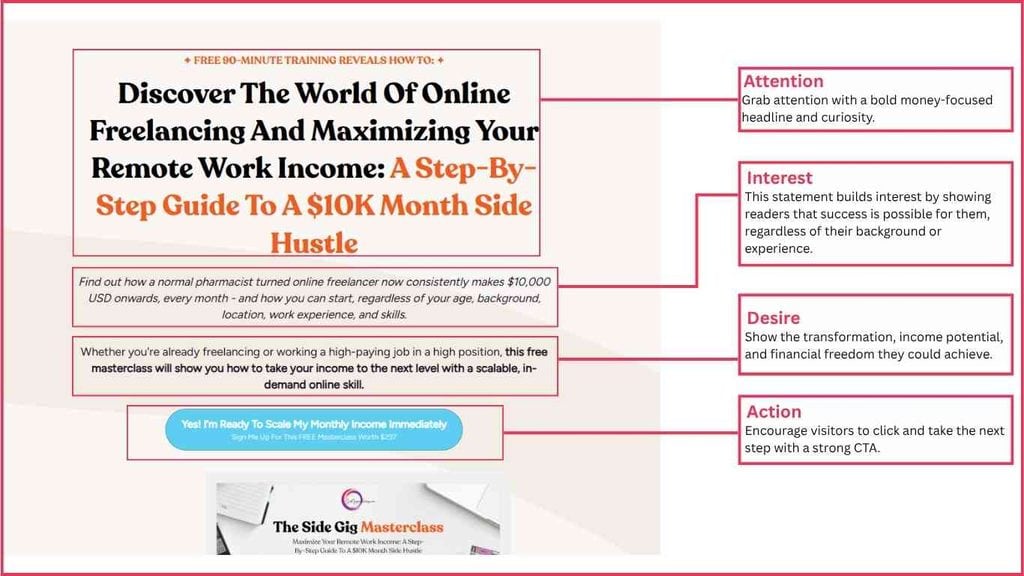
AIDA copywriting: Side Gig Masterclass Landing Page
- 3. This example shows how I use AIDA copywriting in a confirmation email to keep subscribers engaged and encourage the next step.
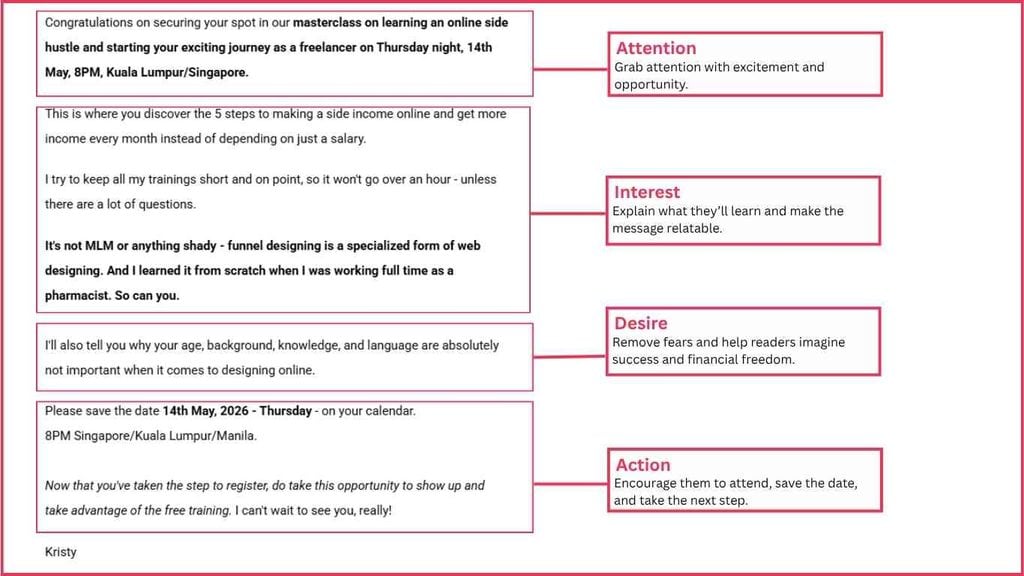
AIDA copywriting: Confirmation Email
AIDA vs. PAS: Which Copywriting Framework Should You Use?
Both AIDA and PAS are proven frameworks. Understanding the main difference between them is one of the more advanced marketing topics worth getting clear on because choosing the right approach for your individual campaign can meaningfully change your results.
| Feature | AIDA | PAS | Best used for |
| Structure | 4 stages (Attention, Interest, Desire, Action) | 3 stages (Problem, Agitate, Solution) | Longer journeys vs. quick pain-point hits |
| Focus | Full journey: awareness to purchase | The solution: pain to relief | Aspiration vs. urgency |
| Tone | Aspirational and exciting | Empathetic and urgent | — |
| Psychology | Focuses on the gain | Focuses on avoiding pain | — |
The AIDA Framework
A linear model that guides a potential customer through the entire psychological journey, from awareness to desire to purchase. It is the right approach when you want to take someone from a cold state all the way through to buying.
Use AIDA copywriting for sales pages, landing pages, email marketing sequences, product launches, webinar registrations, YouTube channel scripts, and any format where you have space to build the customer journey properly.
The PAS Framework
A problem-first approach that identifies a specific pain point, intensifies the emotion around it, and presents your solution as the relief. It moves faster than AIDA and works best when the target audience already knows they have a problem.
Use PAS for Facebook ads, Instagram ads, cold email, short-form social media content, and lead generation campaigns where you need to connect with pain quickly and move people to the next step fast.
Which One Should You Choose?
Choose AIDA copywriting when you want to inspire your target market and show them a better future. It focuses on benefits, possibilities, and the positive transformation your offer creates.
Choose PAS when you want to show your target audience that you understand their struggle and have the best solution. It focuses on pain, frustration, and the relief your offer delivers.
In simple terms: AIDA focuses on pleasure and possibility. PAS focuses on pain and relief. They are different approaches for different audiences at different stages of awareness. The right choice depends on your campaign’s main goal, your target market, and how well your audience already understands their own problem.
What About the ACCA Model?
While we are covering advanced marketing topics, it is worth mentioning the ACCA model, a variation of AIDA copywriting that adds a fifth stage between Interest and desire.
ACCA stands for Awareness, Comprehension, Conviction, Action. It is sometimes used in B2B or government institution contexts, where audiences need more time to understand a complex product or policy before they can develop desire for it.
The main difference between AIDA and ACCA is the “Comprehension” stage, where you help the reader fully understand the problem or solution before trying to create emotional desire.
For most marketing campaigns targeting consumers, AIDA is more direct and more effective. But for different scenarios involving highly technical products, institutional buyers, or audiences new to a category, ACCA gives copywriters a useful framework for slowing down the explanation before accelerating the persuasion.
Final Thoughts: Great Marketing Is Not About Selling
The AIDA copywriting formula has survived since the late 19th century not because it is clever, but because it is true. People move from awareness to action the same way they always have; they need to be stopped, interested, persuaded, and shown what to do next.
Whether you are writing your first Instagram ad, your tenth landing page, or a cold email sequence for a new client, the AIDA copywriting formula gives you a structure to work from. Use it, adapt it for different audiences, and let it guide your copywriting process until the four stages feel like second nature.
As Ann Handley puts it, the goal is always to make the reader the hero. AIDA is just how you build the story around them.
Great marketing is not about selling a product. It is about solving a specific problem for a specific person and showing them, clearly and compellingly, the next step to take. That is the AIDA copywriting formula. That is good copy. And that is what gets results.