

This post may contain affiliate links. If you use these links to buy something we may earn a commission at no extra cost to you. Thank you for your support!
A client has posted a job, received dozens of proposals, and is deciding whom to interview. Before they spend time reading every pitch, many will click a few profiles. Your profile has one job in that moment: make it easy to believe you can solve their specific problem. That is what Upwork profile optimization is really about. It is not about sounding impressive to everyone. It is about becoming the obvious choice for the work you want more of.
A strong profile can support your proposal strategy, help you appear in relevant searches, and earn invitations while you are focused on client delivery. Whether you are building a side gig after work or refining a six-figure service business, the principles are similar: be specific, credible, and easy to hire.
What Upwork profile optimization actually changes
Your Upwork profile is part storefront, part sales page, and part proof file. Clients use it to answer a few fast questions: Does this freelancer offer what I need? Do they understand my industry or outcome? Can I trust them to deliver?
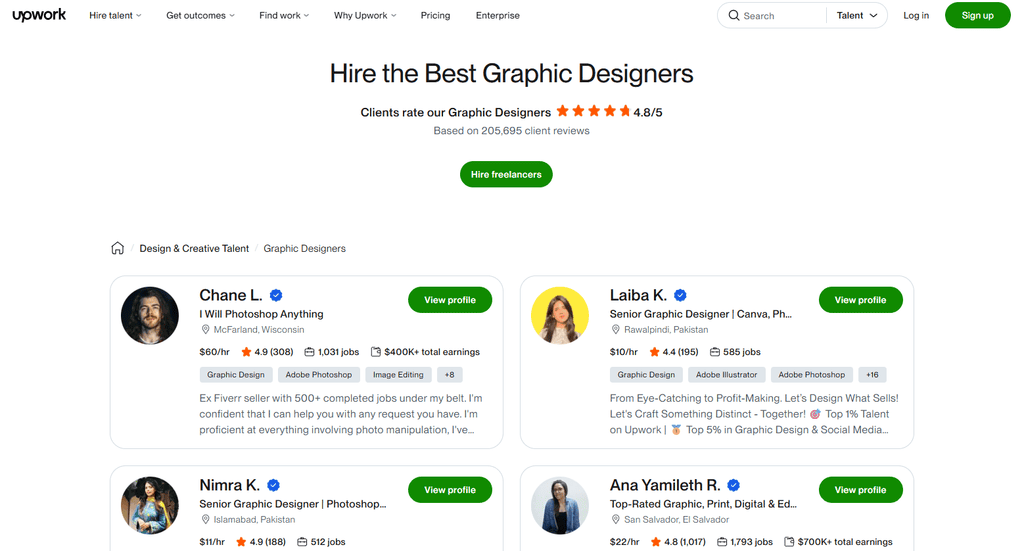
Generic profiles make clients work too hard for those answers. A headline like “Virtual Assistant | Data Entry | Social Media | Customer Service” may be honest, but it gives no reason to choose you over another generalist. A sharper version, such as “Virtual Assistant for Coaches: Inbox, Calendar, and Client Onboarding,” signals a buyer, a service, and a useful result.
Specializing does not mean you can never accept adjacent work. It means your main profile message leads with the service you want to sell. You can still discuss related skills in your overview and proposals. Think of your profile as your front door, not a complete list of every task you have ever done.
Build a profile around client outcomes
Start by choosing one primary service and, ideally, one client type or business situation. A video editor might work with YouTube educators. A copywriter might focus on ecommerce email campaigns. A bookkeeper might serve service-based businesses that need clean monthly books.
This focus makes every part of the profile stronger: your title, samples, keywords, work history, and proposals begin telling the same story. It also helps you decide which jobs deserve your attention. Treat Upwork profile optimization as a positioning exercise first and a keyword exercise second.
| Profile element | What clients need to see | A stronger approach |
| Title | Your core service at a glance | Name the service and a relevant niche or outcome |
| Overview | Why you are a safe, useful choice | Lead with the client problem you solve |
| Portfolio | Evidence of quality and range | Show work that matches your target projects |
| Skills | Relevance to the job | Select skills that reinforce your main offer |
| Employment history | Professional context | Frame previous roles around transferable results |
| Availability | Whether you can take the project | Keep it accurate and update it when capacity changes |
Write a headline that earns the click
Your title has limited space, so do not spend it on soft labels such as “hardworking,” “passionate,” or “expert.” Clients are searching for capabilities, not personality traits.
Use a simple formula: service + specialty, audience, or outcome. For example:
“Email Copywriter for SaaS and B2B Brands”
“Shopify Product Description Writer for Beauty Brands”
“Short-Form Video Editor for Coaches and Podcasters”
“Meta Ads Specialist for Local Lead Generation”
The best option depends on your market. If you have a clear niche, include it. If you are still testing offers, lead with a highly searchable service and add a differentiator. “Web Designer | High-Converting Squarespace Sites” is more focused than “Creative Designer and Digital Marketer.”
Make the first lines of your overview do real work
Clients may only see the opening portion of your overview before deciding whether to keep reading. Begin with the result you provide and the people you help. Do not open with “Hi, my name is…” or a long story about why freelancing matters to you.
A practical opening might read: “I help course creators turn long-form content into email campaigns that nurture subscribers and sell offers.” That sentence immediately tells a buyer whether they are in the right place.
Then add a short explanation of your process, the deliverables you handle, and the business benefit. For a social media manager, that might include content planning, captions, scheduling, and reporting. For an SEO writer, it could be keyword-led blog content, on-page formatting, and subject-matter research.
Finish with a low-pressure invitation to discuss the project. Keep the tone confident. You do not need to promise overnight results or claim that every project will transform a business. Clear expectations build more trust than oversized promises.
Turn experience into proof
Many new freelancers worry they have no Upwork reviews, so they write a profile that apologizes for being new. Please do not do that. You may be new to the platform without being new to the skills clients need.
Draw proof from past employment, personal projects, volunteer work, internships, certifications, client work completed elsewhere, or assets you created for your own business. A former admin assistant can highlight calendar management, documentation, and client communication. A retail manager can show team coordination, reporting, and operational problem-solving. A marketing student can create thoughtful sample campaigns for a clearly labeled mock brand.
Your portfolio should make your offer tangible. Upload polished samples with titles that explain the assignment and outcome. Instead of “Email sample,” use “Welcome Email Sequence for a Fitness Coach.” Add a short note on what you were responsible for, the audience, and the strategic choice behind the work.
For confidential projects, remove sensitive information or create an anonymized case study. You can describe the goal, your scope, and the type of result without exposing a client’s private data. Never share work you do not have permission to display. If you turn a confidential project into a short case study, a tool like Designrr can help you format it as a clean PDF sample you can attach where documents are allowed.
Use numbers carefully
Specificity is persuasive, but only when it is true and understandable. If a campaign produced a 32% increase in booked calls, say what period or comparison that number represents when possible. If you do not control the final business result, describe the output instead: “Built a 12-email launch sequence” or “Edited 24 weekly podcast episodes.”
For newer profiles, metrics are not required. Strong samples, a sensible process, and a focused offer can carry plenty of weight.
Choose skills and keywords without gaming the system
Upwork search relevance matters, but keyword stuffing makes a profile harder to read and less believable. Use the phrases clients naturally use when posting your kind of job. If you offer podcast editing, relevant terms may include audio editing, podcast production, Adobe Audition, Descript, show notes, and audio cleanup. Select only the skills you can confidently perform.
Place important terms naturally in your title, opening overview, portfolio descriptions, and skills list. Repeating the same phrase five times in one paragraph will not make a client trust you more. A profile should read like a capable professional wrote it for another human being. Done well, Upwork profile optimization reads like clear writing, not a keyword puzzle.
If you offer more than one service, keep your main Upwork profile focused on your strongest skills and most relevant experience. Use your portfolio, work history, and skill descriptions to demonstrate related specialties. Upwork now highlights the experience most relevant to a client’s search or job opportunity, so a clear, complete profile matters more than maintaining separate specialized profiles.

Price for the stage you are in
Your rate communicates positioning, but it is not the only factor clients consider. Setting it too low can attract buyers who compare freelancers on price alone. Setting it high without relevant proof can reduce early conversations. The right starting point depends on your service complexity, local and global competition, portfolio strength, turnaround time, and how much strategy is included.
Use your profile rate as a reasonable signal, then scope each project properly in your proposal. A fixed-price landing page, for example, should account for research, revisions, messaging, and design coordination if those are part of your process. Do not let a profile rate force you into underpricing a larger project.
As you collect stronger feedback, better samples, and repeatable results, update your positioning and rate. Upwork profile optimization is not a one-time polish. It is a business asset you improve as your skills and client standards grow.

Review your profile like a client would
Before changing everything at once, inspect your profile with one question in mind: “If I needed this service, would I know exactly why to contact this person?” Read your title and first two overview lines on a phone. Review your first six portfolio items. Check that your profile photo is current, professional, and approachable. Make sure your availability and language details are accurate.
Then compare your profile with successful freelancers in your category, not to copy their wording, but to notice patterns. What outcomes do they lead with? How do they name their samples? Which questions do they answer before a client asks? Borrow the clarity, not the claims. Canva Pro makes it easy to design consistent portfolio cover images, so your samples look like one cohesive offer.
Your profile does not need to be perfect before you apply for work. It needs to make a believable promise and back it up with relevant evidence. Improve it after every meaningful project, every new skill, and every lesson from a sales call. Each update is a small step toward work you can do from anywhere, clients who respect your value, and an income built on skills you own.