

This post may contain affiliate links. If you use these links to buy something we may earn a commission at no extra cost to you. Thank you for your support!
A client posts a job at 9:00 a.m. By lunchtime, they may have 30 proposals saying some version of, “I’d love to help.” That is why learning how to write winning proposals matters so much for freelancers. Your proposal is not a formality after you find a lead. It is the sales conversation that earns you the chance to work with them.
The good news? You do not need to sound corporate, overly polished, or desperate to stand out. You need to make the client feel understood, show that you can solve the right problem, and give them a clear, low-friction next step that requires very little effort, thought or commitment from them to take the next step.
Whether you are pitching on Upwork, replying to a LinkedIn inquiry, or sending a proposal after a discovery call, the fundamentals are the same. Let’s make your next proposal far more likely to get a reply.
Start With the Client’s Actual Goal
Clients rarely hire freelancers because they want a specific deliverable. They hire because they want what that deliverable can do for their business.
A business owner may ask for five emails. What they may really want is more sales from a product launch. A coach looking for a virtual assistant may not simply need admin support. They may need their calendar, leads, and client onboarding organized so they can spend more time selling and serving.
Before you write, look for the outcome behind the request. Read the job post twice. Visit their website or social media if it is available. Review any information from your call, intake form, or messages. Then reflect their goal back to them in plain language.
Instead of writing, “I am an experienced social media manager,” try: “You are already creating valuable content. The opportunity is turning it into a consistent posting system that keeps your brand visible and sends more people to your offer.”
That opening tells the prospect you paid attention. For busy clients, that alone puts you ahead of many applicants.

How to Write Winning Proposals Without Sounding Generic
A proposal should feel written for one person, not copied and pasted for 50 jobs. You can absolutely use a framework to save time, but the client-facing sections must be tailored.
Start with a short opening that names their project, goal, or concern. Then connect it to the service you provide and the result you can help create. Keep the focus on them before you talk about yourself.
For example:
> Hi Maya, your new course has a strong offer, but the sales page needs to guide readers from “this sounds interesting” to “I need this now.” I can help you reshape the page around your audience’s objections, desired transformation, and a clearer call to action.
Notice what this does not do: it does not start with a long biography, list every skill, or make a huge income promise. It gets straight to the client’s situation.
After that, include a sentence or two about your relevant experience. Relevance matters more than a massive list of credentials. A conversion copywriter should mention sales pages or launches. A video editor should mention the type of videos, pacing, or platform the client needs. A bookkeeper should mention the accounting cleanup, reporting, or systems experience connected to the job.
If you are newer, do not pretend to have ten years of experience. Lead with your process, transferable skills, sample work, training, or a thoughtful observation about the project. Clients hire capable people who communicate well, not only people with the longest resume.
Make the Scope Easy to Understand
A proposal gets stronger when a client can quickly see what they are buying. Vague language such as “I’ll manage your marketing” creates uncertainty. Specific scope builds confidence and helps protect you from scope creep later.
Write the deliverables, timeline, revision limits, and responsibilities in simple terms. For a website designer, that may include a five-page website, mobile optimization, two revision rounds, and a two-week launch timeline after receiving content. For an email marketer, it may include strategy, copywriting, setup, testing, and reporting for a defined campaign.
You do not need a long bullet list for every small project. But when a project has several moving parts, use a clear breakdown:
- What you will deliver
- What the client needs to provide
- When each stage will happen
- How feedback and revisions will work
- What is outside the agreed scope
| Proposal section | What to include | Example |
|---|---|---|
| Deliverables | Exactly what the client receives | 5-page website |
| Timeline | When work will be completed | 2 weeks after receiving content |
| Revisions | Number of revision rounds | 2 rounds |
| Client responsibilities | What you need from them | Copy, images and brand assets |
| Out of scope | Work not included in the fee | Additional pages or new features |
Clear proposal boundaries help clients understand exactly what they are buying while protecting freelancers from scope creep
This is not about making the proposal feel legalistic. It is about making it easy to say yes because the work feels organized.
Presentation reinforces that organized feeling. Designing a clean proposal template in Canva Pro with a simple scope breakdown, timeline, and your branding—makes your offer easier to read and signals professionalism before the client reaches the price.

Show Proof That Reduces Risk
Hiring a freelancer always feels like a risk to a client. Will the work be good? Will it be on time? Will communication disappear halfway through the project?
A big part of how to write winning proposals is lowering that perceived risk, because clients hire the freelancer who feels like the safe choice, not the one with the most impressive resume.
Your proposal should answer those concerns with proof. The best proof is a relevant result, testimonial, portfolio sample, or case study. Keep it brief and connected to the client’s need.
You might write, “For a recent e-commerce client, I rewrote their abandoned cart sequence to make the offer and objections clearer. The campaign generated a 22% lift in recovered revenue over the first month.” If you do not have results to share yet, point to a well-matched sample project and explain your approach.
Operational proof also counts. Mention that you use a project board, provide weekly updates, or deliver work in milestones. A client who has had a poor freelancer experience may value reliability as much as creative talent.
Be accurate with every claim. Promising a specific revenue result when you cannot control the offer, traffic, or sales process can hurt your credibility. Strong freelancers sell the quality of their work and process, not fantasy outcomes.
Price the Work With Confidence and Context
A price dropped into a proposal with no explanation can make clients compare you only on cost. Give your fee context by tying it to the scope and value of the work.
For a straightforward project, a simple line works: “The investment for the complete email sequence, including strategy, copy, and two revision rounds, is $1,200.” For a larger engagement, break the work into phases or milestones. This can make a bigger project feel more manageable while protecting your cash flow.
It depends on the client and service whether you should include one price or options. A client with a very defined project may prefer one clear recommendation. A client who has different budget levels may respond well to two or three packages, such as a basic editing package and a higher-level package that includes strategy or repurposing.
Do not create cheap packages just to win the job. If your lowest option does not allow you to do quality work profitably, it is not a real offer. Your proposal needs to support the business you are building, whether that is a flexible side gig or a growing agency.

End With One Clear Next Step
Many proposals lose momentum because they end with, “Let me know what you think.” That puts all the work back on the client.
Knowing how to write winning proposals means never leaving the reader guessing—you close by making the very next action obvious and easy to take.
Instead, tell them what happens next. Invite them to book a short call, approve the scope, reply with answers to one or two questions, or choose a package. Make the action specific and easy.
For example: “If this approach feels aligned, reply with your preferred package and your target launch date. I’ll send over the agreement and first invoice so we can reserve your project slot.”
On freelance platforms, you may want to end with a question that starts a conversation: “Do you already have your brand guidelines and product details ready, or would you like help organizing those before we begin?” A useful question gives the client an easy reason to respond.
Follow Up Without Chasing
A thoughtful follow-up is professional. It is not pushy. If a warm lead has not replied after three to five business days, send a short note that references the project and restates the next step.
You can say, “Hi Jordan, checking in on the proposal I sent for your podcast editing project. I have availability to begin next week if you would like to move forward. Happy to answer any questions about the workflow or timeline.”
One follow-up is often enough for a small freelance project. For larger B2B work, you may use a more structured follow-up sequence, especially when there are multiple decision-makers. The goal is to stay helpful and visible, not to pressure someone who is not ready.
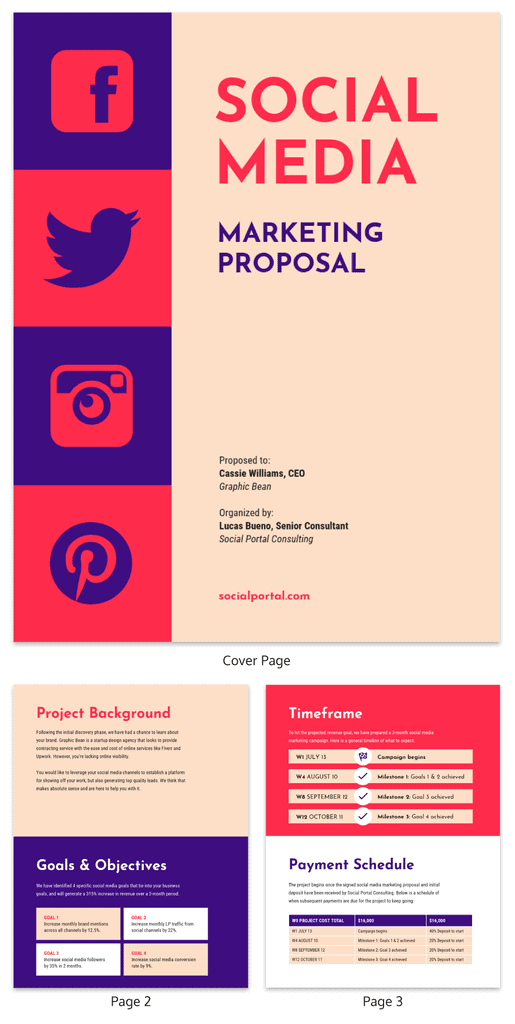
Image Source: A clear, well-designed layout is part of how to write winning proposals, when scope, timeline, and payment stages are easy to scan, clients find it easier to say yes.
A Proposal Framework You Can Reuse
Use this simple structure as your starting point, then personalize it for every lead:
> Hi [Name], > > Based on your goal to [desired outcome], I recommend [your approach]. This will help you [business benefit]. > > I have experience with [relevant project, skill, or result], and for your project I would deliver [key deliverables] by [timeline]. The investment is [price], including [what is included]. > > To get started, [one clear next step].
Keep this saved as a template, but never send it untouched. A simple system in Notion makes this effortless. It stores your proposal framework, reusable scope blocks, and past results in one place, then pull from them to build each custom proposal in minutes instead of starting from scratch. Add the detail that shows you understand their business. That is where the magic happens, lah.
Every strong proposal is a small demonstration of what it will be like to work with you: clear thinking, good communication, useful ideas, and respect for the client’s goals. Send the next one before it feels perfect. Each proposal you write is not just a chance to land a project. It is practice in becoming the kind of freelancer clients remember, recommend, and rehire.