

This post may contain affiliate links. If you use these links to buy something we may earn a commission at no extra cost to you. Thank you for your support!
A lot of people say they want to hire a virtual assistant, but when you ask what they actually need, the answer is often blur. “Help me with admin” can mean inbox cleanup, calendar management, customer support, lead research, social media scheduling, or all five. That is why understanding the job description of virtual assistant work matters so much, whether you want to become a VA or hire one without wasting time and money. Knowing what employers actually look for in a job description of virtual assistant role can also help you decide which skills to develop first.
Virtual assistant work is broad by nature. It sits at the intersection of operations, communication, and online business support. Some VAs handle repetitive admin. Others become the right hand of a founder and manage moving parts across the business. Same job title, very different day-to-day reality.
What is the job description of virtual assistant work?
At its core, the job description of virtual assistant work is simple: a virtual assistant provides remote support services that help a business owner, team, or executive save time and stay organized.
That support can be administrative, technical, creative, customer-facing, or operational. The role is usually remote, task-based, and highly dependent on the client’s business model. A VA working for a real estate consultant will have a different scope from a VA supporting a course creator, ecommerce store, or agency owner.
This is where many beginners get confused. They think virtual assistant is one fixed job. It is not. It is more like an umbrella category covering multiple support functions.
Core responsibilities in a virtual assistant role
Most virtual assistant roles include a mix of administrative and coordination work. These are the tasks clients commonly expect, especially in general VA positions.

Administrative support
Administrative support is the most traditional part of the role. This often includes managing calendars, scheduling meetings, organizing files, data entry, preparing documents, updating spreadsheets, and handling basic online research.
These tasks may sound simple, but they carry real value. Business owners are often paying for speed, accuracy, and mental relief. If a VA can keep things moving without constant supervision, that alone makes them valuable.
Email and communication management
Many clients hire VAs to reduce communication overload. That can mean sorting inboxes, labeling emails, drafting replies, following up with leads, or responding to customer inquiries using templates and brand guidelines.
For a more advanced VA, this can expand into client onboarding, chasing invoices, checking in with vendors, or acting as the first point of contact for the business.

Scheduling and coordination
A virtual assistant often acts as the person making sure nothing falls through the cracks. This includes booking appointments, confirming calls, sending reminders, coordinating across time zones, and keeping project timelines visible.
If you are organized and good with details, this part of the role can be a strong fit. If you hate follow-ups and moving calendars around, maybe not your best lane.
Customer support and client care
VAs handling client onboarding may also set up intake forms in Jotform to collect client details, project requirements, and other information before work begins. Some VAs also handle support tickets, social DMs, refund requests, FAQs, and onboarding communication. In small businesses, the VA may help maintain client relationships by making sure people get replies fast and have a smooth experience.
This type of work needs patience, clear writing, and emotional control. You do not need to sound robotic. You do need to sound professional.

Specialized virtual assistant responsibilities
Once you move beyond general admin, VA work can become much more specialized. This is where rates usually go up.
A specialized VA might manage social media scheduling, upload blog posts to WordPress, build simple email campaigns, create Canva graphics, update CRM records, generate leads, or assist with bookkeeping. Some VAs support launches, podcasts, webinars, or ecommerce operations.
Offering design support is easier with a tool like Canva Pro, which lets a VA produce branded social graphics, carousels, and simple marketing assets fast. Being able to hand a client ready-to-post visuals is exactly the kind of specialized value that raises your rate.
The title still says virtual assistant, but the value proposition shifts. Instead of “I help with tasks,” it becomes “I manage this function of your business.” Big difference.
Clients are often happy to pay more when you solve a more specific problem. A VA who can organize an inbox is useful. A VA who can manage a launch calendar, prep email broadcasts, and coordinate affiliates is operating at a different level.
Learning an email platform like ActiveCampaign is what makes that jump possible – you can set up broadcasts, automations, and launch sequences clients will gladly pay more for. If you want a gentler starting point, MailerLite is simpler and budget-friendly while you build the skill.
Skills clients expect from a virtual assistant
You do not need to know everything to become a VA, but there are some baseline skills that show up in almost every solid job description.
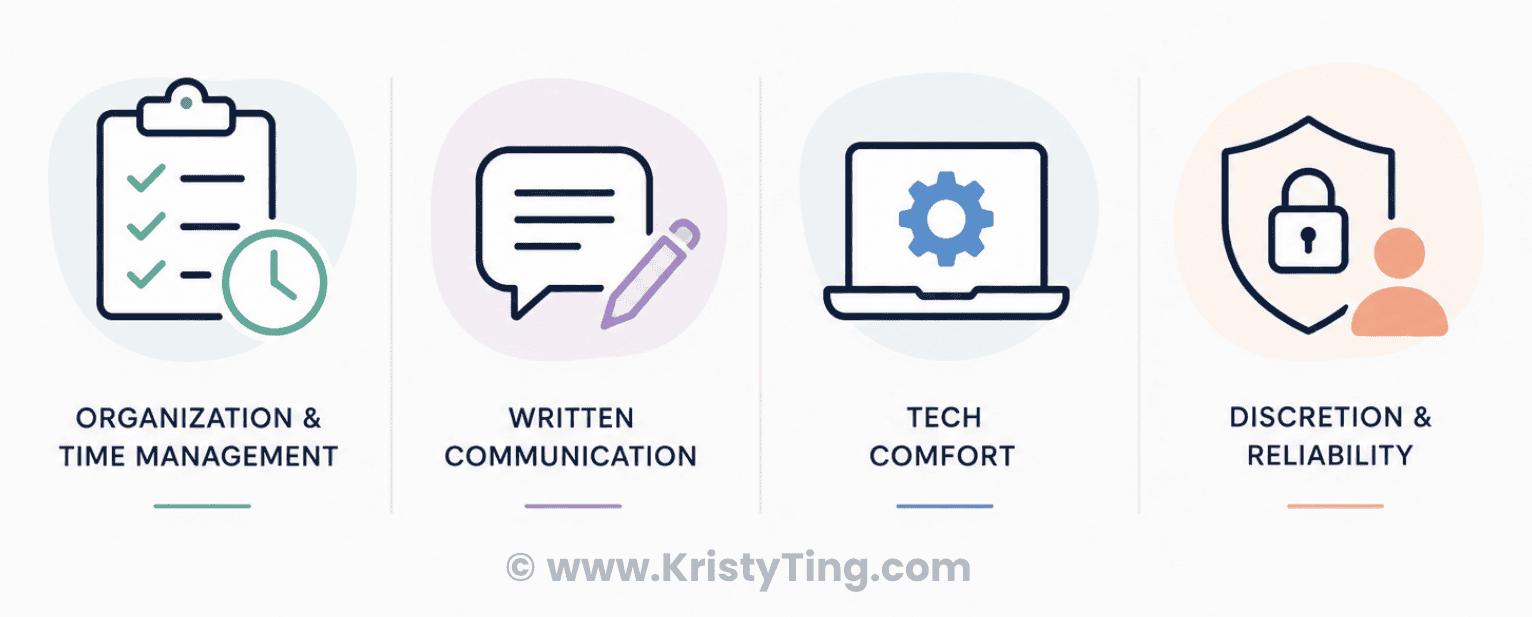
Organization and time management
This is non-negotiable. A VA is often hired because the client does not have time to keep up with all the details. If your own systems are messy, it will show fast.
Good VAs track deadlines, document processes, and stay on top of recurring tasks without needing repeated reminders.
Written communication
A lot of VA work happens through email, chat, and task management tools. Clear writing matters. Grammar does not need to be fancy, but it should be clean, direct, and easy to understand.
This matters even more if you are handling customer support or client-facing communication.
Tech comfort
Most virtual assistants use tools like Google Workspace, Microsoft Office, Zoom, Slack, Trello, Asana, ClickUp, Calendly, Canva, and CRM platforms. You do not need expert-level skills in every tool, but you should be comfortable learning new software quickly.
The strongest VAs are resourceful. If a client uses a tool you have not touched before, you learn it fast and move.
Discretion and reliability
VAs often work with passwords, customer information, payment records, private documents, and internal business conversations. Trust is part of the job.
Clients want someone dependable, not just available. If you miss deadlines, disappear, or need constant chasing, they will replace you. Harsh, but true.
What a sample virtual assistant job description often includes
When you read a job description of virtual assistant work, you will usually see a similar structure. The client describes the business, lists tasks, mentions required tools, states working hours or time zone preferences, and outlines the level of experience needed.
A typical description may say the VA will manage calendars, respond to emails, perform online research, update spreadsheets, schedule social posts, and support light customer service. It may also ask for experience with Google Docs, Excel, project management tools, and strong English communication.
That said, job posts are not always written well. Some clients cram three roles into one listing and still want to pay entry-level rates. If a “VA” job also expects sales closing, full social media strategy, graphic design, ad management, and daily availability across multiple time zones, that is not a standard assistant role. That is several jobs wearing one label.
General VA vs executive VA vs specialized VA
This distinction matters if you are positioning your services.
A general virtual assistant usually handles broad admin support. An executive virtual assistant works more closely with a founder or executive and often manages higher-level coordination, confidential information, and business priorities. A specialized virtual assistant focuses on one area such as marketing, ecommerce, operations, or tech support.
| VA Type | Typical Responsibilities | Skill Level | Best For | Earning Potential |
|---|---|---|---|---|
| General VA | Inbox management, scheduling, data entry, research, basic admin | Beginner-friendly | New VAs building experience | $ |
| Executive VA | Executive scheduling, confidential tasks, coordination, priorities, high-level support | Intermediate–Advanced | Organized VAs with strong judgment and communication | $$–$$$ |
| Specialized VA | Email marketing, CRM, social media, launches, ecommerce, tech or operations | Intermediate–Advanced | VAs who want to niche down and build expertise | $$–$$$+ |
None of these is automatically better than the others. It depends on your strengths and income goals. General VA work can be a solid entry point. Executive assistant work often pays more because it requires stronger judgment. Specialized VA work can become the fastest route to premium pricing if your skill set is tied to revenue or operations.
How to read a VA role like a business owner
If you want better clients, stop reading job descriptions like a task taker only. Read them like a service provider.
Ask yourself what problem the client is actually trying to solve. Are they overwhelmed with admin? Missing follow-ups? Struggling to keep up with customer messages? Behind on content publishing? When you understand the business pain behind the task list, you can position yourself better and even suggest a smarter scope.
This is where many freelancers level up. They stop saying, “I can do data entry.” They start saying, “I can keep your backend organized so leads, clients, and deadlines do not slip.” Same basic skill, stronger business value.
Is virtual assistant work a good freelance service?
Yes, especially if you want a flexible online service with room to grow. VA work can start with admin and expand into operations, marketing support, launch management, customer experience, or project coordination.
The trade-off is that the market is broad, so vague offers tend to compete on price. If you simply market yourself as a VA who can do anything, you may attract confused clients and low-budget work. If you define your scope clearly and package your freelance services around specific client needs, you become much easier to hire
That is also why the best virtual assistants do not stay “just admin” forever unless they want to. Over time, many build niche offers, learn how to price retainer services, or develop agency-style support services.The role can absolutely grow with you.
When you understand the real job description of virtual assistant work, you stop seeing it as random online tasks and start seeing it as business support with clear value. That shift changes how you present yourself, how you price, and how seriously clients take you. If you are stepping into this space, keep your offer clear, your systems tight, and your standards high. There is plenty of room here for someone who knows how to make a business run better.