

This post may contain affiliate links. If you use these links to buy something we may earn a commission at no extra cost to you. Thank you for your support!
A potential client asks ChatGPT, “Who can help me improve my email funnel?” Or they search Google for “best local SEO consultant for a small business.” If your expertise is not represented in the sources those tools trust, you may never make the shortlist, even when you are genuinely the better freelancer for the job.
That is why answer engine optimization matters. It is not another flashy acronym to chase. It is a practical way to make your expertise easier for AI-powered search tools and traditional search engines to understand, verify, and recommend. For freelancers, consultants, and small agencies, that can turn useful content into warmer leads and a more durable client acquisition channel.
What Is Answer Engine Optimization?
Answer engine optimization, often called AEO, is the practice of structuring your website, content, and digital presence so answer engines can pull clear, credible information from it when responding to a user’s question.
An answer engine is any platform that gives a direct response rather than simply a page of blue links. Think Google AI Overviews, ChatGPT, Perplexity, Microsoft Copilot, and voice assistants. Each platform works differently and changes often, so nobody can promise placement. But they share a basic goal: give users a useful answer quickly, supported by information they can trust.

Traditional SEO is still part of the picture. You still need pages that search engines can crawl, topics people look for, and a website that is clear to navigate. AEO adds another layer: Can an AI system identify the exact question you answer, understand your point of view, and see evidence that you are qualified to answer it?
For a freelance copywriter, that might mean a page explaining how welcome email sequences work, with sample outcomes and a clear service offer. For a bookkeeper, it could be a plain-language guide to monthly financial reporting for service businesses. The goal is not to write for robots. It is to make your expertise easy for both people and machines to use accurately.
| Traditional SEO | Answer Engine Optimization (AEO) | |
|---|---|---|
| Main goal | Rank pages in search results | Make content easy for answer engines to understand and use |
| Typical discovery | Search-result links | Direct AI-generated answers and summaries |
| Content focus | Keywords and search intent | Specific questions and direct answers |
| Important signals | Relevance, authority, site structure | Clear answers, evidence, expertise and consistency |
| Ideal content | Useful pages targeting search intent | Clear, quotable answers backed by credible information |
| Does it replace SEO? | — | No — AEO builds on strong SEO foundations |
SEO helps people find your content, while AEO helps answer engines understand and use it.
Why Freelancers Should Care About Answer Engine Optimization
Freelancers do not need millions of visitors. They need the right people to find them at the moment a business problem becomes expensive enough to solve. Answer engines are increasingly part of that research process.
A founder may ask which metrics belong in a Meta ads report. An online coach may ask how much a sales page should cost. A marketing manager may compare CRM setup specialists. These are all high-intent questions, and they sit close to a buying decision.
This creates an opening for specialists with real experience. Generic content farms can publish plenty of words, but they cannot easily replace your process, your client perspective, your original examples, or the patterns you have seen across actual projects – That is your edge!
There is also a service opportunity here. Many small businesses have heard that AI search is changing marketing, but they do not know what to do beyond adding a few FAQs to their website. A freelancer who can audit existing content, improve service pages, gather proof, and build an answer-focused content plan has a timely offer to sell.
The trade-off is that AEO is not a quick traffic hack. Visibility can be difficult to measure because answer engines may summarize information without sending a click. You cannot control which sources they cite. Treat it as part of a wider visibility strategy that includes SEO, referrals, partnerships, email marketing, and a clear offer.

Build Content That Deserves to Be Used as an Answer
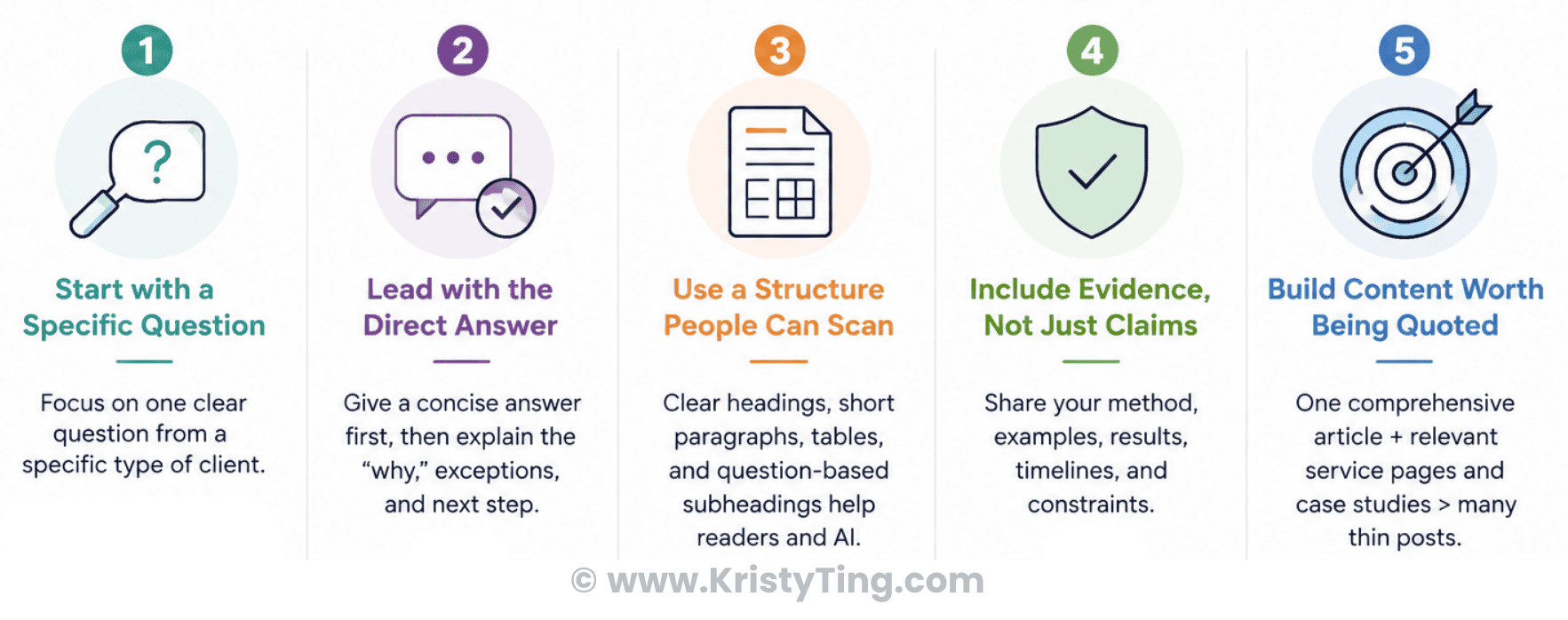
The best AEO content starts before the writing. It starts with a specific question from a specific buyer.
This is where answer engine optimization becomes practical: you are not chasing keywords, you are answering the exact question a buyer types before they hire.
Broad topics such as “email marketing tips” are competitive and vague. A more useful topic for an email marketer could be “What should a seven-email welcome sequence include for a course creator?” That question signals a type of client, a service context, and a problem you can solve.
A blog-focused SEO tool like RankIQ helps you find the exact questions buyers search and see what a thorough answer should cover, so your content is more likely to be understood and cited. It keeps your writing specific rather than vague.
Lead with the direct answer, then earn attention
Do not make readers scroll through a long personal story to reach the point. Open a section with a concise, accurate answer in two or three sentences. Then explain the reasoning, exceptions, examples, and next step.
For example, a web designer writing about website timelines could state that a five-page service website often takes three to six weeks once the client provides copy, branding, and feedback on time. That is more useful than saying every project is different and leaving it there. You can still explain the variables: custom development, delayed approvals, photography, and revision rounds all affect the schedule.
Specificity gives answer engines material to quote or summarize. More importantly, it gives a prospective client confidence that you understand the work.
Use a structure people can scan
Clear headings, descriptive page titles, short paragraphs, tables where a comparison truly needs one, and logical question-based subheadings all help. A page should make sense when someone lands in the middle of it.
Avoid publishing ten thin posts that repeat the same idea with slightly different keywords. One comprehensive article built around a real question, supported by relevant service pages and case studies, is usually a better long-term asset.
Include evidence, not just claims
AI-generated content has made generic advice very easy to produce. That raises the value of information that is difficult to fake.
Show your method. Explain what you reviewed, what you changed, and why. Use anonymized client examples if confidentiality applies. Include before-and-after metrics when you have permission and proper context. Mention the type of business, timeline, budget range, or constraints that shaped the outcome.
A social media manager might explain why posting daily was not the answer for a B2B client with a lean team, then share the content system that made three weekly posts sustainable. A virtual assistant could outline the boundaries that prevent calendar management from becoming round-the-clock availability. This type of practical detail builds trust far better than claiming to be “results-driven.”
Turn Your Website Into Proof of Expertise
Answer engines look beyond one blog post. They assess signals across the web and across your own site. Your job is to make the story of your business consistent.
Strong answer engine optimization depends on consistency, because these tools judge the whole picture of your business, not just one well-written post.
Your homepage should say who you help, what result you help create, and which services you offer. Your service pages should explain deliverables, fit, process, and common questions. Your About page should include relevant experience, credentials, and a real point of view. If you have testimonials, case studies, podcasts, guest features, or speaking experience, present them clearly.
This does not mean you need a giant website before you can market yourself. A focused site with three strong pages can outperform a cluttered one with 50 vague posts. Start with the pages closest to revenue, then build content around the questions your ideal clients ask before they hire.
Make sure your business details are consistent wherever you appear online. Use the same business name, role, core offer, and location or service area where relevant. Inconsistencies create confusion for humans first, and systems second.

A Simple AEO Content Plan for Your Freelance Niche
Choose one service you want more of. Then collect questions from sales calls, discovery forms, client emails, comments, and search suggestions. Pay attention to questions clients ask right before they buy, not only beginner questions with high search volume.
Keep those questions somewhere you will actually use them. A simple database in Notion lets you log buyer questions, map them to content, and track what you have published, so your AEO plan stays organized instead of scattered across notebooks.
Next, create a small topic cluster. A conversion copywriter could publish a guide to sales page pricing, an article on what a sales page project includes, a case study about improving conversion messaging, and a service page for sales page copy. Each page has a different job, but together they make the specialty unmistakable.
Then refresh what you already have. Update outdated statistics, remove filler, strengthen vague introductions, and add examples drawn from your current work. Content freshness helps only when the update improves accuracy or usefulness. Changing the publication date without improving the page is not a strategy.
Finally, use conversations to refine your content. When a prospect asks a question your site does not answer well, that is market research handed to you for free. Build the answer into your next article, service page, proposal template, or onboarding material.

Can You Sell Answer Engine Optimization as a Service?
Yes, but sell outcomes and deliverables rather than promising that a client will appear in every AI response. The platforms are not fully transparent, and their behavior evolves fast. Ethical positioning protects your reputation.
A practical AEO package might include a content and visibility audit, revisions to core service pages, a list of buyer questions, content briefs, author or expert bio improvements, testimonial and case study recommendations, and tracking for branded search growth, organic leads, and referral patterns. If you also offer SEO, you can position AEO as a modern extension of your existing work.
Pricing depends on the business size, number of pages, research depth, and whether you are writing the content or only providing strategy. A one-time audit can be a useful entry offer. An ongoing content retainer makes sense when the client needs consistent publishing, expert interviews, case-study development, and measurement.
Do not call it AEO just because the phrase is popular. If your package is really blog writing, say so. If it includes strategy, technical cleanup, content architecture, and authority-building recommendations, explain that scope plainly. Clear expectations make clients more likely to see the value.
The freelancers who benefit most from this shift will not be the ones trying to game a new platform. They will be the ones who become easy to trust, easy to understand, and easy to hire. Pick one buyer question this week, answer it with real expertise, and let that piece become an asset that keeps working while you work from anywhere.