
This post may contain affiliate links. If you use these links to buy something we may earn a commission at no extra cost to you. Thank you for your support!
A lot of beginners buy a course hoping it will remove the fear, give them a clear path, and somehow lead to clients by next week. Fair enough – when you are new, a good freelancing course for beginners can save you months of second-guessing. But not every course is built to help you get paid, and that is where many people waste both money and momentum.
If you are comparing options right now, the real question is not just which course looks the most polished. It is whether the course helps you build a freelance skill, package it into an offer, and actually sell that offer in the market. Some courses teach inspiration. Some teach theory. The better ones teach income.
What a freelancing course for beginners should actually teach

A beginner course should do more than explain what freelancing is. You can get that from free content in ten minutes. A course worth paying for should shorten the path between interest and your first paid project.
That means it should cover a skill that can be sold online, such as copywriting, social media management, graphic design, video editing, virtual assistance, or email marketing. It should also teach the business side: how to define a service, who to offer it to, how to price it, how to pitch, and how to handle early client conversations without sounding blur or desperate.
This is where many courses fall short. They spend too much time on motivation and not enough time on deliverables. If a course says you can work from anywhere and earn your dream income, nice. But if it does not show you what you are delivering to clients and why someone would pay for it, that message stays very abstract.
A strong beginner course also helps you avoid the fake confidence trap. Watching lessons can make you feel productive, but freelancing only becomes real when you can complete a service task, communicate value, and ask for money. The course should keep pulling you back to action.
The best courses focus on one transformation
If a course promises to teach ten freelance skills, five platforms, three business models, and agency scaling all at once, be careful. Beginners do better with focus.
The best freelancing course for beginners usually centers on one clear outcome. That could be landing your first client as a virtual assistant, building a beginner copywriting portfolio, or learning enough social media management to offer monthly retainers to small businesses. A focused course gives you a shorter runway and less confusion.
There is a trade-off here. A broad course can help you understand the overall freelance landscape, which is useful if you truly do not know what service fits you yet. But if you already have a direction, a specialized course is often more valuable because it gets practical faster.
In other words, the right choice depends on where you are. If you are still deciding between writing, design, admin, or marketing support, a beginner overview course can help. If you already know your lane, go narrower.
What to check before you buy
Most sales pages are written to make a course sound life-changing. Some are excellent. Some are pure vibes. Before paying, look past the branding and ask a few basic questions.
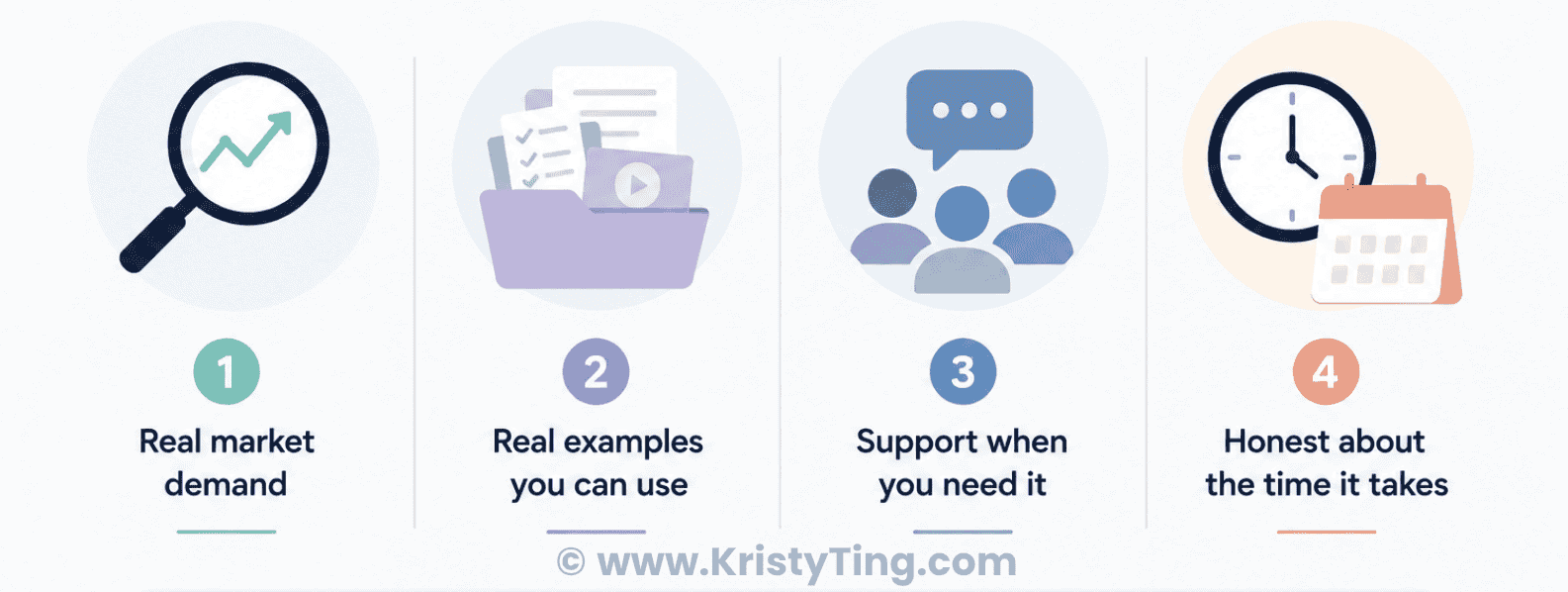
First, does the course teach a skill with real market demand? A course can be beautifully made and still not lead anywhere if the skill is too vague or too hard to monetize as a beginner. Services tied to business outcomes tend to have clearer demand. Think lead generation, email marketing, ad support, content writing, design for brands, or admin support for busy founders.
Second, does it include real examples? Templates, sample proposals, outreach scripts, client briefs, project walkthroughs, and feedback examples matter a lot. Beginners need to see what good work looks like. Without that, lessons can feel encouraging but hard to apply.
Third, is there support? This does not have to mean live coaching every week. Even a community, office hours, or assignment feedback can make a big difference. When you are new, one answered question can save you days of overthinking.
Fourth, does the course talk honestly about timing? Be cautious with anything that makes paid freelancing sound instant. Yes, some people land clients quickly. Others need longer to practice, refine their offer, and build confidence. A course that admits this is usually more trustworthy than one that only sells speed.
Red flags beginners should not ignore
One of the biggest red flags is when the course sells freelancing as easy money without emphasizing skill-building. Freelancing is flexible, yes. It can absolutely grow into strong income. But clients are paying for outcomes, not your enthusiasm.
Another red flag is heavy focus on mindset with very light training. Mindset matters, of course. If you freeze every time you need to send a pitch, that is a problem. But confidence should be built through reps, not just pep talks.
Watch for outdated platform advice too. A course that relies too much on old Fiverr hacks or generic Upwork bidding strategies may not reflect how competitive those platforms are now. Platform-based freelancing can still work, but the tactics need to match current buyer behavior.
You should also be careful with courses built around unrealistic income claims. If every testimonial jumps from zero to five figures in a month, ask yourself whether the course is showing the full picture. Sustainable freelancing is usually more boring than viral success stories – and that is not a bad thing.
Should you choose a general course or a skill-specific one?
This is where many people get paiseh and delay the decision because they think they need the perfect answer. You do not. You need the next useful answer.
A general freelancing course is helpful if you need help understanding offers, pricing, pitching, and client workflow across the board. It gives you business foundations. That can be smart if you already have a skill from your day job or side projects but do not know how to turn it into a service.

A skill-specific course is usually better if you do not yet have a sellable offer. It teaches you the actual work first, then often shows you how to sell it. This route is stronger for people entering freelancing from scratch, especially if they need a practical path to their first paid project.
For many beginners, the best combination is not one giant course. It is one skill course plus one business-training layer. Learn what to deliver, then learn how to package and sell it.
How to tell if a course matches your goals
The course that is right for a full-time career switch is not always the same one that is right for a side hustler who wants an extra $500 to $1,500 a month. Your goal changes what makes a course good.
If you want fast entry, look for services with shorter learning curves and simpler deliverables, like virtual assistant work, social media support, basic content writing, or data-focused admin services. If you want higher long-term earning potential, you may lean toward copywriting, paid ads support, funnel building, email marketing, or design systems. Those can take longer to learn but often support stronger pricing.
If your chosen skill leans visual towards social media management, graphic design, or building a portfolio, having a tool like Canva Pro makes it far easier to produce client-ready work and samples while you are still learning. Having polished proof early makes your first pitches much stronger.
Also think about your preferred work style. Some people want recurring monthly clients. Others want project-based work. Some enjoy communication-heavy roles, while others prefer production work behind the scenes. A good course should align with the kind of freelance life you actually want, not just the one that sounds impressive online.

This is one reason Side Gig Accelerator-style training resonates with so many newer freelancers – it connects skills to income, not just information to motivation. That distinction matters when you want results.
A simple way to choose without overthinking
If you are comparing several options, score each course on four things: skill relevance, business training, proof of student results, and support. Not flashy branding. Not big promises. Just those four.
Then ask yourself one more question: after finishing this course, what exact service could I offer within 30 days? If you cannot answer that clearly, the course may be too broad, too theoretical, or too disconnected from paid work.
It helps to write that answer down somewhere you will actually revisit. A simple workspace in Notion lets you map your service, pricing, and first outreach list in one place, so the course knowledge turns into an actual plan instead of forgotten notes.
The best freelancing course for beginners is not the one with the most modules. It is the one that helps you become useful to a real client, quickly enough that you do not lose momentum. That might be a low-cost starter course, a niche training program, or a mentorship with more hands-on guidance. It depends on your budget, your timeline, and how much structure you need.
Start with the course that gets you into motion, not the one that makes you feel like you need six more months to be ready. Paid freelancing usually begins when you decide you are ready to practice in public, imperfectly but seriously.