

This post may contain affiliate links. If you use these links to buy something we may earn a commission at no extra cost to you. Thank you for your support!
The fastest way to stay broke as a freelancer is to wait for clients to magically appear after you set up a profile and post once on LinkedIn. That is not how most service businesses grow. If you want to learn how to get freelance clients, you need a simple client acquisition system you can repeat every week, even when motivation is low and your schedule is packed.
The good news is this is learnable. You do not need a huge audience, fancy branding, or ten years of experience. You need an offer people understand, proof that you can help, and a way to consistently get in front of buyers.
How to get freelance clients starts with a clear offer
A lot of freelancers make client acquisition harder than it needs to be because they describe themselves too broadly. If you say, “I do copywriting, social media, admin, design, and a bit of marketing,” clients do not know when to hire you. A clearer offer makes you easier to refer, easier to remember, and easier to trust.
Instead of selling every skill you have, pick one core service and one type of client if possible. For example, “email copywriter for ecommerce brands” is clearer than “freelance writer.” “Virtual assistant for coaches who need inbox and calendar management” is clearer than “online admin support.”
This does not mean you are locked in forever. It just means your marketing becomes sharper. You can always expand later once demand is steady.

Build proof before you chase volume
Before you send 100 cold messages, make sure your basics are solid. Most clients are not expecting perfection, but they do want signs that you can do the work.
Your proof can come from client work, sample projects, case studies, internship experience, your own business, or even mock pieces if you are newer. A beginner copywriter can write three strong sample emails. A beginner designer can create brand concepts for imaginary businesses. A newer Meta ads freelancer can audit ad libraries and explain what they would improve.
What matters is relevance. One strong sample that matches the client’s world is more persuasive than ten random portfolio pieces.
You also need a simple online presence. This can be a one-page site, a polished LinkedIn profile, or a portfolio page on a platform. Keep it clean. Show who you help, what you do, and what result you aim for. If someone lands on your page and still feels blur about your service, tighten the message.
The best ways to get freelance clients
There is no single best channel for everyone. The right mix depends on your service, experience level, pricing, and how fast you need income. Still, most freelancers get clients from a handful of proven sources.
Freelance platforms are useful when you want speed and market feedback. Upwork, Fiverr, Contra, and niche job boards can work, especially if your profile is specific and your proposals are tailored. The trade-off is competition and platform fees. For some freelancers, platforms are a launchpad. For others, they become one lead source among several.
Cold outreach works well when you offer a clear service with an obvious business outcome. If you help with lead generation, email marketing, paid ads, SEO, design, or conversion copy, you can often spot businesses that need help and contact them directly. This takes more effort than clicking apply, but it can lead to better-fit clients and higher rates.

LinkedIn is strong for B2B services. If your ideal clients are founders, coaches, consultants, agencies, or SaaS companies, showing up there consistently can bring inbound leads over time. You do not need to become an influencer. You just need to post useful ideas, share examples, and make it obvious what you do.
Referrals are one of the highest-converting channels, but they usually work best after you already have some client experience. Happy clients, former coworkers, friends in business, and collaborators can all send work your way if they know exactly what you offer.
How to get freelance clients with outreach that does not sound spammy
Bad outreach is vague, self-centered, and easy to ignore. Good outreach is specific, relevant, and short.
When you message a potential client, lead with something that shows you understand their business. Mention a page you reviewed, a campaign you noticed, or a gap you can help fix. Then connect that observation to your service. For example, if you are an email marketer, you might point out that a brand has strong traffic but no visible welcome sequence. If you are a web designer, you might note that their site loads slowly or has weak mobile layout.
Do not write an essay. A few lines are enough. The goal is not to close the deal in one message. The goal is to start a real conversation.
Also, outreach works better when you send fewer, better messages. Ten thoughtful emails usually outperform fifty generic ones. If you are going to do cold outreach, block time each week for research, personalization, follow-up, and tracking. Treat it like a business function, not a random burst of panic when work gets quiet.
Your content should help clients pre-qualify themselves
Content marketing is slower than outreach, but it compounds. If you share useful content around your service, you make it easier for clients to trust you before they ever book a call.
This can look different depending on your niche. A copywriter might post before-and-after email rewrites. A bookkeeper might explain common mistakes service businesses make with cash flow. A video editor might show how better hooks improve watch time. A virtual assistant might share systems that save founders hours each week.
The point is not to post for vanity metrics. The point is to attract the right people and make your expertise visible. You want a potential client to think, “This person gets my problem.”
If posting every day makes you sian, do not force it. One or two strong posts a week is enough if they are relevant and consistent.
Follow-up is where a lot of clients are won
Many freelancers send one message, hear nothing, and assume the lead is not interested. Sometimes that is true. Often, they are busy, distracted, or not ready yet.
A calm follow-up process matters. Send a second message a few days later. If there is still no reply, follow up again with something helpful, like a quick idea or observation. Keep it respectful and easy to ignore if the fit is not there.
This is especially important for warm leads. If someone replied once, viewed your proposal, asked a question, or said “maybe next month,” do not disappear. Keep light contact. Timing changes. Budgets open up. Priorities shift.
The freelancers who seem to get clients “easily” are often just better at staying visible without being pushy.
This is much easier when you are not doing it all from memory. An email tool like ActiveCampaign lets you set gentle follow-up sequences and stay on warm leads’ radar automatically, so a “maybe next month” does not quietly slip away. If you want something simpler to start, MailerLite handles the basics well at a lower cost.

Make referrals easy instead of hoping for them
If you want more referrals, stop asking vaguely. “Let me know if you hear of anyone” is too loose. People are more likely to refer you when they know exactly who you help and what problem you solve.
Try something more specific. Tell clients, peers, and business contacts the type of company you are looking to work with. Mention the service clearly. If appropriate, remind them after a successful project or when they praise your work.
You can also build referral momentum through partnerships. Designers can refer copywriters. Ads specialists can refer landing page designers. VAs can refer bookkeepers. Service businesses grow faster when complementary freelancers trust each other.
Retention is one of the smartest answers to how to get freelance clients
Yes, getting new clients matters. But keeping clients matters even more. A freelancer with steady retainers usually has less income stress, more predictable workload, and more room to raise rates strategically.
If you want repeat business, do the basics exceptionally well. Communicate clearly. Hit deadlines. Scope projects properly. Suggest next steps when you spot an opportunity. Make the client feel looked after, not managed badly and chased for everything.
Sometimes the easiest next client is the one who already paid you and had a good experience.
That said, not every client should be retained. Low-budget, high-drama clients can block better opportunities. Part of growing is learning which relationships are worth extending and which ones are better left as one-off projects.
Track what is working
If you are serious about growth, measure your lead generation. You do not need a fancy CRM at the start. A spreadsheet is enough.
Track where leads came from, how many pitches you sent, how many replies you got, how many calls you booked, and how many turned into paid work. Over time, patterns show up. Maybe LinkedIn brings better clients than platforms. Maybe referrals close fastest. Maybe your cold emails get replies but your sales calls need work.
Without data, it is easy to assume nothing is working when actually one channel is doing quite well and another is draining your time.
If a spreadsheet starts feeling messy, a simple tracker in Notion can hold your pipeline, outreach log, and follow-up dates in one place. It keeps you consistent without the overhead of a full CRM, which is exactly what most freelancers need early on.
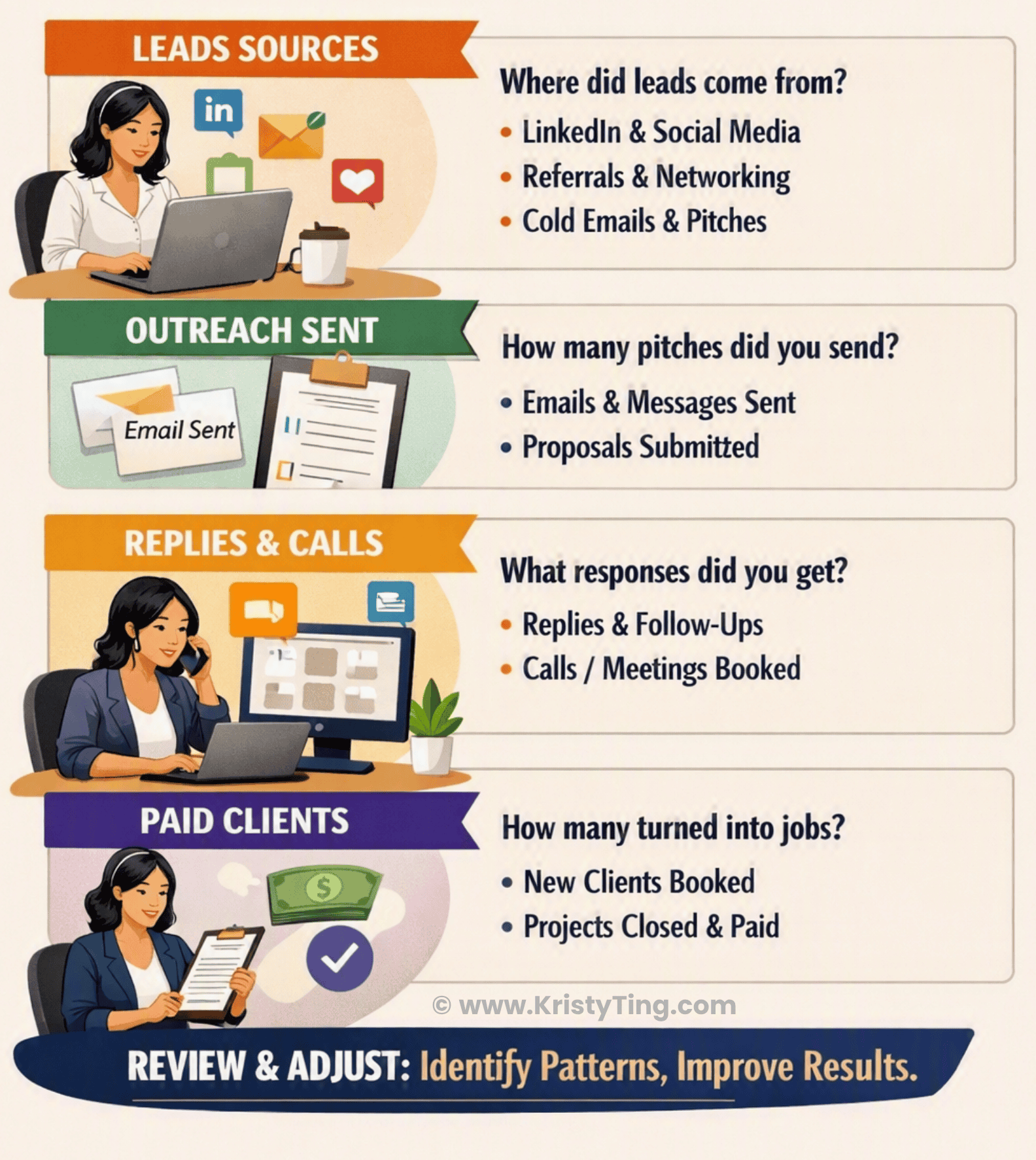
A simple weekly client pipeline
If you want a practical rhythm, keep it simple. Spend one block improving your portfolio or proof. Spend one block publishing something useful. Spend one block sending targeted outreach. Spend one block following up with leads and past contacts. Keep doing that for eight to twelve weeks before you decide a method has failed.
That consistency is boring, yes. But boring is often what gets results.
Freelancing gets easier when you stop treating client acquisition like luck and start treating it like a repeatable business habit. You do not need to do everything at once. Pick two lead sources, tighten your offer, and give people a real reason to remember you. That is how momentum starts.