

This post may contain affiliate links. If you use these links to buy something we may earn a commission at no extra cost to you. Thank you for your support!
A client does not wake up hoping to buy “10 hours of your time.” They want a better sales page, a month of social content, cleaner books, or a website that makes their business look credible. Learning how to package freelance services turns your skills into an offer they can understand, compare, and confidently say yes to.
That matters whether you are offering virtual assistant support on weekends or running a growing design, marketing, or web agency. Packages make your business easier to buy from. They also give you more control over your workload, pricing, delivery process, and income.
Why freelance service packages sell better than open-ended help
Hourly work has a place. It is useful for consulting, complex projects with an unclear scope, and clients who need flexible ongoing support. But leading with an hourly rate can make clients focus on how long something takes instead of what it helps them achieve.
A package shifts the conversation. Rather than saying, “I charge $40 an hour for social media management,” you can say, “I create and schedule a month of strategic content so you can show up consistently without spending your evenings on Canva.” One is a unit of labor. The other is a business outcome.
Packaging also prevents the vague inquiries that drain your time: “Can you help with marketing?” “How much for a website?” “Can you just do a few admin tasks?” A clear offer gives people a starting point while showing that you have a process, not just availability.
This does not mean every package has to be rigid. The goal is to standardize the majority of your work, then price custom additions separately when needed.
Start with one client problem, not every skill you have

Many freelancers create confusing packages because they try to include everything they can do. A copywriter may offer blogs, emails, web copy, product descriptions, ads, and strategy in one broad menu. A VA may offer 30 different tasks. The client sees options, but not a clear reason to hire them.
Start by choosing a specific type of client and a problem they already recognize. For example, a service-based coach may need a launch email sequence. A local business may need short-form videos that bring in bookings. A busy online founder may need their inbox, calendar, and customer support organized.
Ask three practical questions before building the offer:
- What result does this client want within the next 30 to 90 days?
- What work do I repeatedly do well enough to create a reliable process?
- What boundaries do I need to protect my time and profit?
Your answer does not need to be niche forever. It simply gives your marketing a sharp starting point. You can expand later once you know which services are profitable and enjoyable to deliver.
How to package freelance services around outcomes
A good package has four parts: a defined outcome, clear deliverables, a delivery timeline, and firm boundaries. Clients need all four to understand what they are paying for.

Define the transformation first
The transformation is the before-and-after story. A bookkeeping package might move a business owner from months of messy transactions to organized monthly financial records. A web designer might move a new consultant from an unfinished DIY site to a polished site that is ready to collect leads.
Be realistic with your claims. You can promise the work you control, such as a conversion-focused landing page, but you cannot promise a specific revenue number unless you can truly guarantee it. Strong offers are confident without making fantasy promises.
Turn the work into visible deliverables
Deliverables are the tangible parts of the package. For a monthly email marketing package, that could include four promotional emails, one newsletter, copy upload into the client’s platform, and one revision round per email.
Avoid fuzzy language such as “full support,” “complete branding,” or “manage social media.” These phrases invite scope creep because every client has a different definition. Specify quantities, channels, formats, meetings, revision limits, and what the client must provide.
Set a delivery rhythm
A timeline makes an offer feel real. It can be a 10-day website audit, a two-week launch copy sprint, or a monthly retainer delivered in weekly batches. Include onboarding, feedback windows, and final handoff where relevant.
The right timeline depends on your service. A rush option can be valuable, but charge more for it. If a client’s late feedback delays the project, your agreement should explain how that affects the timeline too.
Name what is outside the package
Boundaries are not negative. They make clients feel safer because they know what to expect. If your package includes one landing page, say that additional pages are separate. If you manage Instagram content, clarify whether responding to DMs, filming video, paid ads, and weekend posting are included or not.
This is where many freelancers lose profit, lah. A package is only profitable when the scope matches the price and the time you actually need to deliver it.
Use a simple package ladder
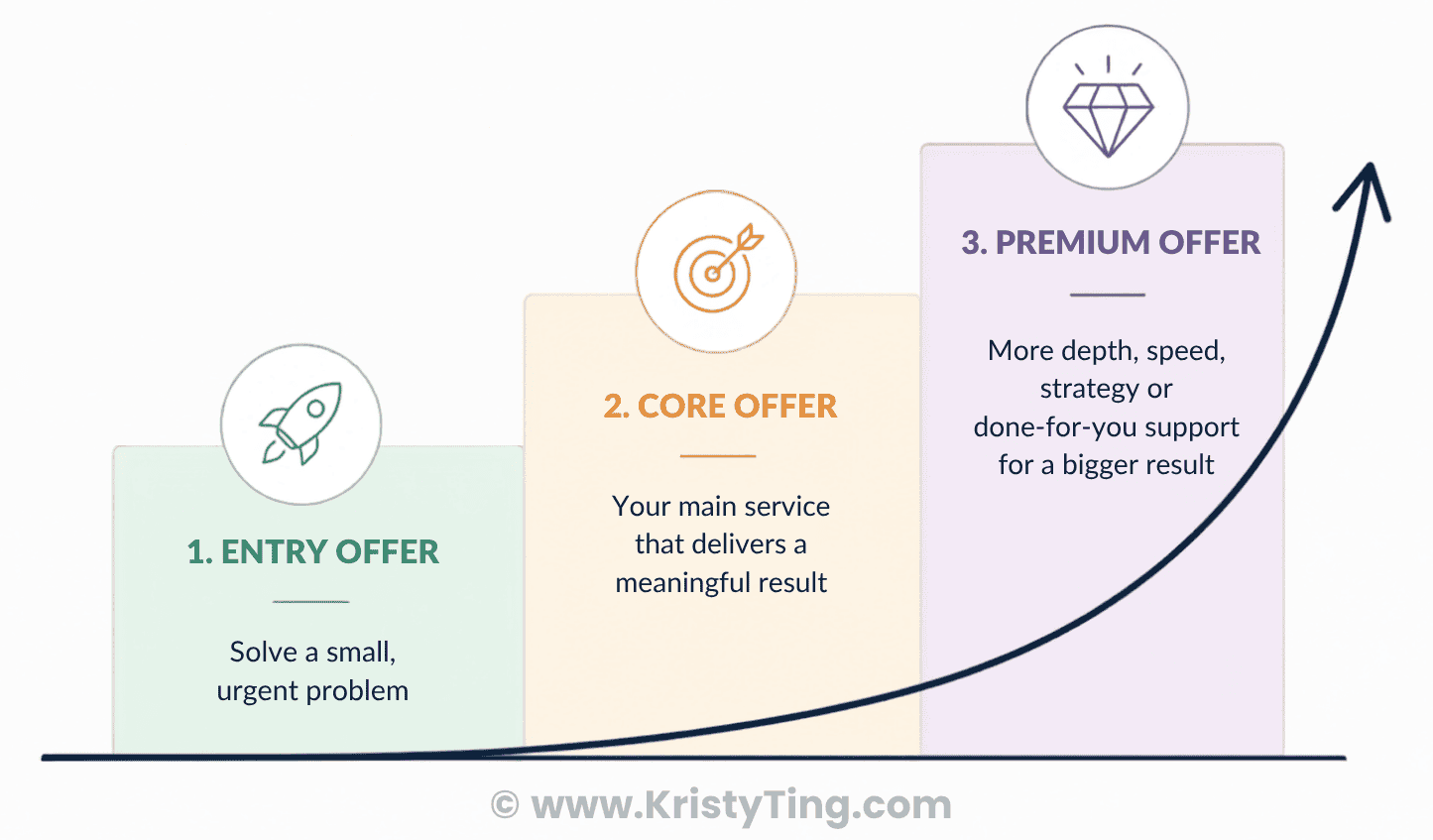
You do not need five complicated tiers. For most freelancers, three choices are enough: an entry offer, a core offer, and a premium offer.
Part of learning how to package freelance services is resisting complexity. A clear three-tier ladder sells far better than a long menu that leaves clients unsure where to start.
Your entry offer should solve a smaller urgent problem. Think of a 90-minute strategy session, LinkedIn profile refresh, email audit, bookkeeping cleanup, or website home page review. It gives a new client a lower-risk way to experience your expertise.
Your core offer is the service you most want to sell. It should produce a meaningful result and have a repeatable workflow. For example, a content manager’s core package may include 12 posts, captions, scheduling, and a monthly content plan.
Your premium offer adds depth, speed, strategy, or implementation. It may include more channels, analytics reporting, team training, a VIP turnaround, or a higher level of done-for-you support. Premium should not mean random extras. Every addition needs to support a bigger result.
If you are new, begin with one core package and one add-on. Selling a clear offer is far more useful than spending weeks designing a fancy pricing page with services nobody has asked for yet.
| Entry Package | Core Package | Premium Package | |
|---|---|---|---|
| Purpose | Solve one smaller urgent problem | Deliver your main client result | Deliver a bigger or faster result |
| Scope | Small and tightly defined | Repeatable core service | Expanded service + strategy |
| Commitment | Low | Medium | High |
| Example | Email audit | Monthly email package | Email strategy + campaigns + automation |
| Best for | New clients testing your service | Your ideal recurring client | Clients wanting deeper support |
| Main goal | Build trust | Become your main seller | Increase value and results |
A simple three-tier package gives clients clear choices without overwhelming them.
Price the package for value and capacity
First, calculate your internal baseline. Estimate the hours for onboarding, client communication, delivery, revisions, admin, and tool costs. Multiply that by the minimum effective rate you need to make the work worthwhile. This is your floor, not necessarily your final price.
Knowing how to package freelance services profitably means pricing from both sides: your real cost to deliver, and the value the outcome creates for the client.
Then consider the value and specialization involved. A sales email sequence that supports a $2,000 program is worth more than general writing practice. A VA who manages sensitive operations and prevents missed leads brings a different level of value than someone completing one-off data entry.
Fixed pricing works well when scope is clear. Monthly retainers work well when clients need ongoing, predictable support. Day rates can work for intensive collaboration, while hourly pricing is often best for advisory work or requests that cannot be defined upfront.
Do not discount a package simply because you can deliver it quickly. Speed is often the result of experience, templates, and a refined system. Clients are paying for the result and the confidence that it will be handled well.

Make the offer easy to say yes to
Your package description should answer the questions a good prospect is already asking: Is this for me? What will I receive? How does it work? What does it cost? What happens next?
Use plain language on your website, proposal, or discovery call. Lead with the result, explain the deliverables, state the investment, and outline the first step. You do not need to reveal every part of your internal process. You only need enough clarity for the buyer to make a decision.
Presenting that offer well helps it sell. A tool like Canva Pro lets you turn your package into a clean one-page overview or proposal that looks professional, which builds trust before the client even reads the details.
Social proof can help, but specificity matters more than hype. A brief example of what changed for a past client, a relevant portfolio sample, or a clear explanation of your workflow can reduce hesitation. For newer freelancers without testimonials, show your thinking through a sample audit, mini case study, or useful content that addresses the client’s problem.
Review your packages after real client work
Your first package is a working draft, not a permanent contract with your business. After every few projects, review where time went, what clients requested most often, which deliverables created the strongest results, and where you felt underpaid.
You may find that a popular add-on deserves to become part of your core package. Or you may realize a low-priced tier attracts clients who need more support than they buy. Adjust the scope, price, or qualification process based on evidence.
A simple workspace in Notion makes this review effortless to track hours, client requests, and results per package so your decisions are based on real data instead of memory. Over time, that record shows you exactly which offers to keep, raise, or retire.
The best package is not the one that looks impressive in a Canva graphic. It is the one you can explain in one sentence, deliver consistently, and sell at a price that supports the flexible, sustainable business you want. Write down one package today, share it with the next right prospect, and let real conversations make it better.