
This post may contain affiliate links. If you use these links to buy something we may earn a commission at no extra cost to you. Thank you for your support!
Have you ever searched for what the difference is between “work from home” vs “work at home”? It sounds the same, right? But it’s actually a little different.
“Work from home” means your work is done for an employer from a home office.
“Work at home” means your work is done at home as a self-employed or business owner.

After the long Covid pandemic, many people who used to physically work at the office began the trend of transitioning to remote locations where their jobs allowed it.
You would be able to spot many of them working from coffee shops, a temporary co-working facility, or even their own home office that was newly built during the pandemic period itself, exciting yes!
Nevertheless, there are still those who prefer administering their duties at their workplace the traditional way, whilst others appreciate working from home as a mix of the two.
A flexible schedule has become a daily aspect that people look forward to, and has also been the signal to the rise of remote work.
It is even true that one’s workplace surroundings have been proven to greatly affect effective work productivity, positive mental health, job satisfaction and company culture including one’s family / personal life.
This is the main reason why many business owners or business leaders nowadays, HR leaders, remote workers, and full-time employees ask a common question of what unique challenges are for each setup and how they may improve on it holistically.
Still with us? Aha, now at the end of this blog, you will be able to know:
- The main differences between “working from home” and “working at home”
- The major benefits and unique challenges for people who work remotely, office employees, and the hybrid model.
- The work style is right for you or for your business.
You might be interested in:Does Remote Mean Work from Home? Best Explained.
Work From Home vs Work at Home: Why One Word Changes Everything
What “Work From Home” Really Means
The work can take place even from a distance, yet the focus is on a firm, client, or business. Your home is where you send the work from, not where it comes from.
This is why “work from home” became the most common way to say
- Employees who work from home
- Freelancers who work with clients
- Companies that offer digital services
- People who run businesses online
You’re still part of a bigger system; you’re simply not there in person.
You might be interested in:19 Best Online Courses For Freelancers In 2025
What “Work at Home” Usually Implies
“Work at home,” on the other hand, often refers to tasks or work that already exist at home.
Think:
- Household projects
- Personal tasks
- Home-based duties
- Sometimes self-employment where the work itself is rooted in the home
Why “Work From Home” Became the Standard
Language evolves based on how we live.
As telecommuting and remote jobs become more and more common, the label “work from home” clearly explains what is happening:
- The work still belongs to a company or client
- You’re just completing it remotely
- Communication take place from your home to the outside world
Having this kind of clarity matters especially in job descriptions, contracts, and business conversations.
You might be interested in: Best Work From Home Computer Setup
Remote Work vs Office Work vs Hybrid Work: A Full Comparison
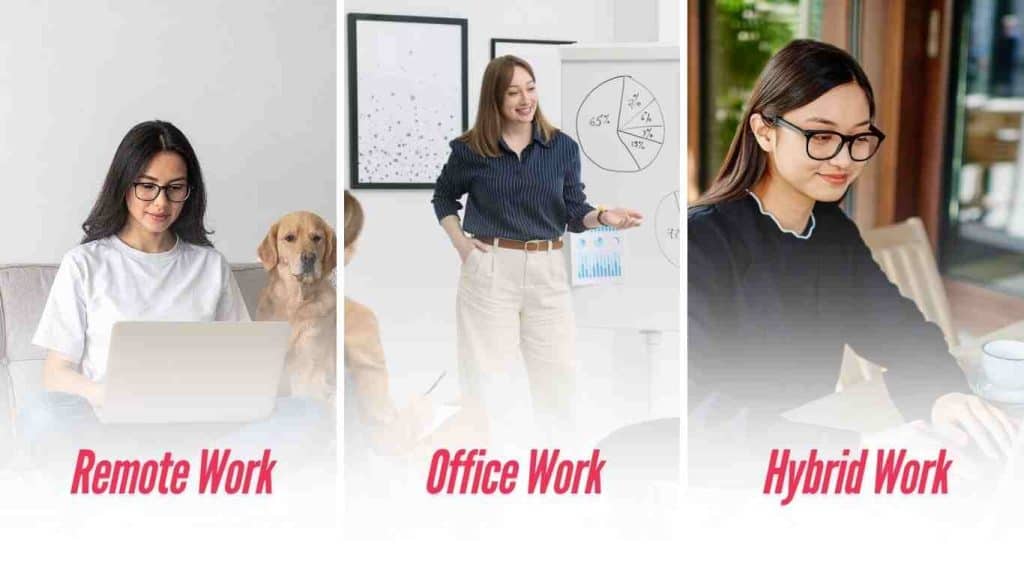
Remote Work (Work From Home): Pros and Cons
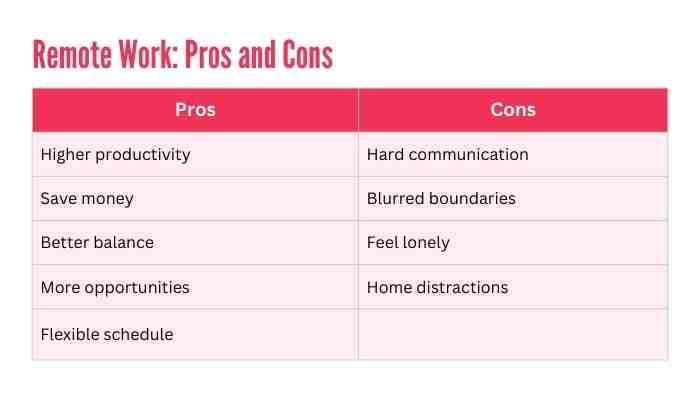
This table shows the main pros and cons of remote work.
You might be interested in: Work from Home Survey Questions Template: 40 Questions for Team Insights
Pros of Remote Work
1. High productivity
One of the biggest myths about remote work is that people perform less efficiently without supervision. No sir. The data says otherwise.
Owl Labs says that 90% of people who work from home say they are just as productive or more productive than people who work in an office.
Only when you have personally experienced how constant interruptions, long commutes, and meetings can affect your performance, this will begin to make sense. When people are given full control of their time, they often do their best work, honest – take me for example, aha!
2. Money-saving
Remote work quietly saves people thousands of dollars every year with less outdoor expenditure to pay for – in fact that savings can be channeled elsewhere e.g. into holidays, yay!
Global Workplace Analytics states that remote workers save between $2,000 and $6,500 a year if you lessen the expenses of having to work face-to-face that includes parking or transportation cost, work clothes, and meals.
For a lot of families, being able to save can directly lower stress and give them more financial freedom.
3. Better work-life balance
People who work from home can plan their days when they have the most energy and without having to worry about their family’s needs, or their own health. That kind of flexibility can give employee satisfaction.
4. More hiring and career opportunities
Working remotely definitively means that you can work from anywhere you want,even when you are located a thousand miles away from your employer.
Employees will have the option to look for jobs from places that are distant or aren’t available in their area, and business owners can hire the best individuals from a larger sample size no matter where they are – the reach can be global!
5. More engagement when done right
Being flexible with your time isn’t just helpful for work – flexibility potentially provides positive motivation effects and makes you feel happier on a greater scale if you manage well.
Gallup suggests that employees who get to work from home are indeed more engaged and happier doing work, simply because it provides them greater flexibility.
Cons of Remote Work
1. Communication challenges
Oops, so working from home is not always a bed of roses. When people work from home, they will need to learn different methods of communication for remote work – without the right processes set in place, teams fall apart quickly and deadlines get missed.
29% of remote workers say that communication issues that arise from working in separate locations tend to become a big problem, and 38% of managers claim that working cohesively without everyone present in the room is indeed difficult.
Most importantly, this is why teams working remotely will need to be, at the very least, familiar with the recommended tools and apps to perform work efficiently, e.g. those that can outline the right processes through follow-up documentation, and clear expectations of what is required of them drawn out early and perhaps periodically.
2. Work and life are not clearly separated
Aha.. having no work-life balance quickly becomes the most common gripe of working from home (surprised?) simply because you might have to give up evenings and weekends to execute tasks that come up out of the blue and need to be looked into right away.
If neither you nor your employer sets clear limits on your job scope and work schedule, you might end up getting burned out.
3. Being isolated and alone
When you work alone, you may begin to feel like a hermit – you no longer have as many opportunities to talk and hang out with other people as you did back at the office.
Unfortunately, being alone and working in solitude for long periods of time can get worse for some people, leading to the risk of clinical depression.
4. Home distractions can interrupt you.
You may not have a private, quiet spot to work at. Family members have a lot of responsibilities to carry, and loud noise from gadgets and frequent interruptions from the young ones at home can potentially heighten stress levels, where much needed focus becomes difficult to maintain!
e.Office Work: Pros and Cons
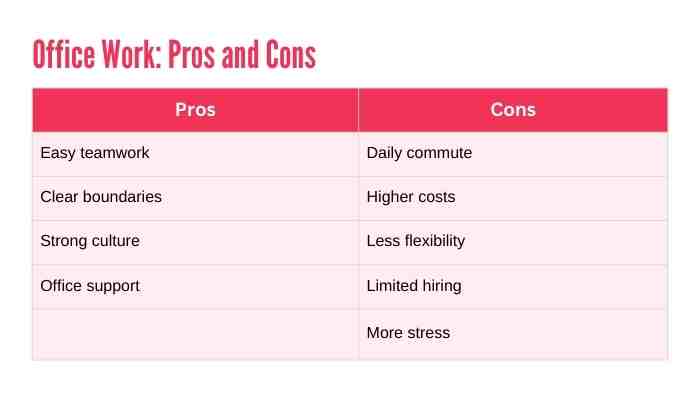
This table lists the main pros and cons of working in an office, with a focus on structure, teamwork, and how commuting and fixed schedules affect work.
Pros of Office Work
1. Easier to work together in person.
No doubt about it: One-on-one conversations are easily made accessible and fruitful when colleagues work in the same building and on the same floor – better yet, in the same room, aha!
Being in the same physical presence enables co-workers to come to a better understanding through body language and touch – such dimensional input is absent over video calls. Humans tend to take offence more easily over email and WhatsApp texts (if you are not a master of Emojis, hah!).
Additionally, you don’t need to wait for reply texts and emails to get the answers you seek – you can just walk right over to the person next to you conveniently in your office!
2. A clear separation between work and home
Since you’re not working at home, you get to take leave from the noise at home and leave house errands to your spouse back home – You get to focus on work. When at the office, you will not have to face diaper-changing exercises, perform cooking needs for the family nor ferry kids or parents about – In a nutshell, this can be a healthy route to help your brain relax, aha!
3. Stronger company culture
If you happen to be lucky enough to land an office job with supportive-minded bosses, strong camaraderie can be forged potentially along with a great sense of belonging while lapping up important company values. Working together every day helps bodies mingle and get to know each other and trust each other better – many a time, discovering office romance is the greatest reward, aha!
4. Access to necessary equipment and support
Offices generally have good internet, printers, meeting rooms, and people who can help you with your computer. People nearby can usually fix things fast if they break or stop working. This keeps things moving along easily and avoids too many delays.
You might be interested in:How Many Mbps Do I Need To Work From Home 2025
Cons of Office Work
1. Daily long commutes
The daily commute takes up hours of time each week, which makes it so much hassle and reduces the time you spend resting.
People who work in offices tend to have to wake up early, drive through peak hour traffic jams in the morning, leave at the end of the day only to face another round of traffic onslaught – this is the hardship of the typical journey to and fro from work.
2. Higher ongoing expenses
Costs for things like gas, food, parking, and business clothes add up quickly and often take up most of your earnings.
3. Limited flexibility
Office jobs usually have set hours. You have to be there at a certain time and leave at a certain time. That can be hard if you need to go to an appointment, take care of someone, or if you’re just feeling extra tired that day.
4. Small talent pool
Jobs that are based in an office limit hiring to a certain area. If you are the one hiring, may miss out on really talented people who live far away. If you are the one putting in the job application, good employers and larger salary packages may be further away from you requiring you to travel long distances.
5. More stress
It’s normal for offices to be loud and busy. Your desk may get visited, the phone may ring, and a lot is happening. All that noise can make you tired and you may find it difficult to focus if you need to think harder.
Hybrid Work Models: Pros and Cons
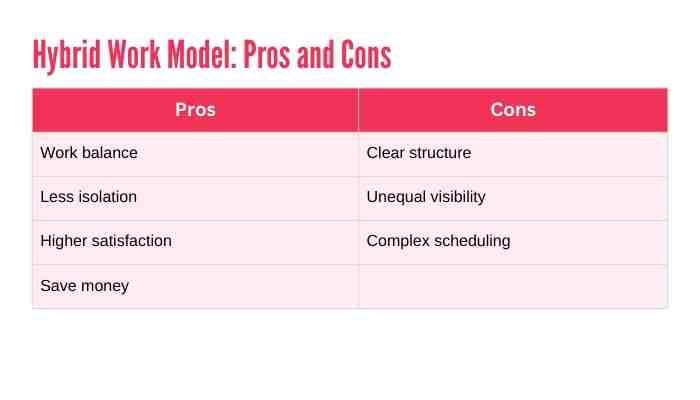
This table highlights the pros and cons of the hybrid work model, which shows a balance between flexibility and working together in person and connecting with your team.
Pros of Hybrid Work
1. Mix of flexibility and in-person connection.
Hybrid work gives employees the ability to work independently without eliminating in-person collaboration – you can either choose to work at home on some days, and then at the office on the rest to fulfill work requirements.
2. Less lonely
Ever wanted to be able to reach into your fridge at home for a nice chilled can of Coke on a hot afternoon while having the option to also eat at the office cafeteria and have awesome long chats with your co-workers the next day? Aha.. It’s important to have social connection options like these, but it’s also important to be flexible.
ScienceDirect research shows that employees who work from home three or more days a week feel more alone, while those who work from home one or two days a week do not. This suggests that hybrid work is a better balance.
3. Higher satisfaction and retention
Heavenly: Hybrid models often give you the best of both worlds.
The Human Resource Consulting Group says that hybrid work makes employees happier because it lets them work from home and keeps a healthy work-life balance.
4. Save money without being completely isolated
Employees still make money.
Global Workplace Analytics claims that employees who work from home part-time save between $2,000 and $6,500 a year by cutting down on commuting and work-related expenses.
Cons of Hybrid Work
1. Requires clear structure
While looking like a pretty obvious choice, if there are no clear job policies, a hybrid setup might fail for numerous reasons especially if one is not organised. When schedules are unclear or ill-maintained, it can lead to frustration and uneven workloads.
2. Risk of unequal visibility
More often than not, in-office workers are likely to receive more recognition for doing the same work simply because workload can be seen, or opportunities with a lot of exposure – this is the reality of being able to show up physically.
3. Planning schedules can be confusing.
Scheduling meetings, collaboration time, and office days requires planning, not guesswork.
Different Tools That Support Any Work Style
- Project management platforms that organize tasks, track progress, and meet deadlines.
- Video conferencing software lets people see and talk to each other online, even in different locations.
- Instant messaging apps help teams send quick messages and stay updated without long emails.
- Collaboration tools allow remote teams to share online files.
- Secure systems help keep company information like passwords safe.
In-Demand Remote and Hybrid Job Titles
According to Forbes, the best remote options and work-from-anywhere roles include:
- Software Engineer
- Social Media Manager
- Product Manager
- Account Manager
- Data Analyst
- Content Writer
- AI Engineer
- Project Manager
- Sales Development Representative
- Product Designer
Which Work Style Best Suits You?
So just before you go all in and decide on your work setup, first take a moment and check in with yourself. No pressure, just honest answers you must seek!
- Do you work better alone or with others?
- Is having flexibility can be beneficial to you, or do you feel better when there is a particular schedule and set work hours?
- Do you enjoy talking to people personally, or is it okay to communicate with people at different times and make updates when you need to?
- And most importantly, what setup really helps your mental health, personal life, and job satisfaction as a whole?
There isn’t one answer that works for everyone. The best way to work is usually the one that fits your style, energy, your needs, and what gives you the most comfort doing your best work.
How to Decide Which Work Style Is Right for Your Business
When I had to figure out how I would run my business several years back, I thought of some factors, including how my team would operate.
Since I’m a funnel builder, an online coach and run an agency, the most of my work happens digitally, thus choosing remote hiring and operations makes the most sense simply because all aspects of the job revolve around digital settings and task-based workloads – we don’t all need to be in the same place or turn up physically at a brick and mortar office place.
We do meet up in-person once a year nevertheless, and that will be for a year-end Retreat along with all my students. Hence, if you run your business entirely online and the tasks can be done digitally, remote work has to be the best option for your business.
However, if most of the work relies on hands-on work or requires constant face-to-face collaboration, an office setup is definitely a better option.
For me, as an employer, choosing the right work style comes down to which of the models perfectly aligns with what supports high productivity, communication, and the kind of business. It will be helpful if you look at it from that perspective too.
Wrapping Up:
At the end of the day, the better option between “work from home” vs “work at home” is what fits you.
There are full-time employees who better fit with the office environment, fixed office hours with office equipment, and support employee engagement, corporate culture, and workplace culture. Others love the remote working setup.
Whatever you choose, from coworking space, home environment, or hybrid arrangement, each comes with unique challenges. Everyone has different needs.
Now, just over a few years, I have transitioned to a work-from-home setup and I am thankful that I no longer have to wage war with daily traffic jams. As an employer, this has allowed me to hire from a broader talent pool (across country borders too!) and gain time with my family members, especially my kids, when I am able to travel and attend their school activities, which I enjoy a lot of course, aha!
And if your needs change? You get to change your work model too just like I did eventually, ie from pharmacist in a retail pharmacy outlet to stay-at-home-mum and a digital CEO. That’s the real advantage of modern remote work arrangements…they’re meant to evolve with you.
Frequently Asked Questions
1. What is the difference between remote work, office work, and a hybrid work model?
Remote job refers to employment that allows remote employees to work from a location other than a physical office, which could be their home, living room, coffee shop, or co-working space. On the other hand, office work happens in a traditional office setting, with employees working together in an office with a set of deadlines to finish a certain task.
While a hybrid work model combines the two. Hybrid workers can exist in both worlds, remote and office settings, which allows businesses to implement a mix of flexibility and collaboration. For many business owners and leaders on today’s trend, this method is the best fit for modern work styles and different team requirements.
2. What are the biggest challenges and cons of remote work?
The biggest challenges and cons of remote work include communication gaps, isolation, and having difficulties to set boundaries between work and personal lives. Remote team members often rely on asynchronous communication, online messages, and virtual meetings, which can feel a little bit hard to establish connections.
Studies suggest that lack of regular social interaction and face-to-face interaction can have a huge impact on mental health if teams don’t have enough structure or social support. Clear job policies, the right tools, and consistent social support to one another help reduce these issues.